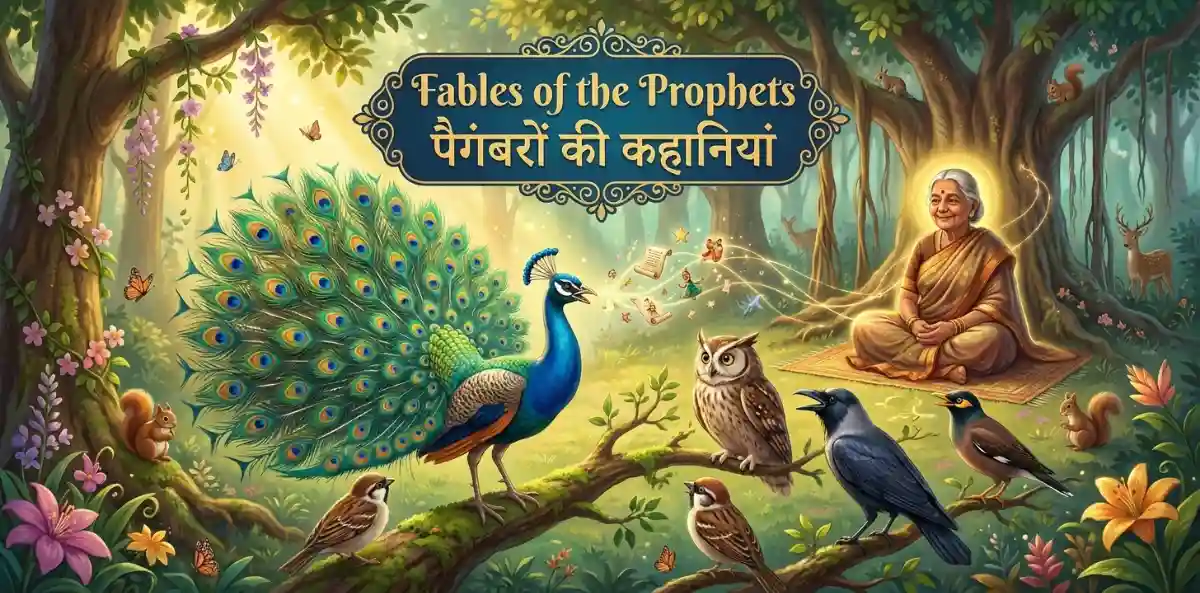
Have you ever sat with your grandmother on a warm summer evening, listening to stories that seemed too fantastical to be true? Stories where animals talked, trees danced, and ordinary people performed extraordinary deeds? These were not just random tales—they were fables of the prophets, or as we say in Hindi, “पैगंबरों की कहानियां” (Paigambaron ki kahaniyan) or “नबियों की नीति कथाएं” (Nabiyon ki neeti kathayein).
The phrase “fables of the prophets meaning in Hindi” refers to moral stories and parables that have been passed down through generations, often attributed to wise prophets, spiritual teachers, or grandmothers who had a knack for turning everyday wisdom into unforgettable narratives. In Khushwant Singh’s famous work “The Portrait of a Lady,” he uses this exact phrase to describe his grandmother’s stories—tales that seemed so ancient and wise that they could have only come from prophets themselves!
According to Aesop’s Fables tradition, a fable is a short story that teaches a moral lesson, often featuring animals or inanimate objects as characters. When combined with “prophets,” it takes on a deeper, almost mystical quality—these aren’t just any stories; they’re wisdom tales with divine origins.
But what makes these stories truly special? Let me take you on a hilarious journey through the world of prophetic fables in Hindi with a story that’ll make you laugh, think, and perhaps call your grandmother to hear more tales!
The Great Peacock Parliament: A Fable of the Prophets Story | मोर की महान संसद
Part 1: When Pride Wore Feathers | जब घमंड ने पंख पहने
Once upon a time, in a lush forest near the banks of the Ganges, there lived a peacock named Rajesh (yes, even peacocks had very Indian names in this story). Rajesh wasn’t just any peacock—he was THE peacock. His feathers shimmered with colors that would make rainbows jealous. His dance could stop monsoon clouds mid-pour. He was, in every sense, the Shahrukh Khan of the bird kingdom.
“आओ देखो मुझे!” (Come behold me!), Rajesh would announce every morning, spreading his magnificent tail feathers in a 180-degree arc that blocked the sunrise.
The other birds had to schedule their mornings around Rajesh’s daily display. The early-bird worm-catching had to wait. The sparrows’ breakfast meetings? Postponed. Even the wise old owl, who should have been sleeping, had to keep one eye open because Rajesh’s performance was simply too loud to ignore.
One day, a traveling mynah bird from the city arrived in the forest. She had seen the world—from the chaotic markets of Delhi to the serene beaches of Goa. She had perched on the shoulders of saints and pecked crumbs from the hands of children. In short, she knew a thing or two about life.
“भाई साहब” (Brother dear), she said to Rajesh with a smirk, “आपकी तो बड़ी शान है!” (You certainly have great glory!)
Rajesh puffed up with even more pride. “Of course! I am the most beautiful bird in all of creation. Even the angels in heaven don’t have feathers like mine!”
The mynah chuckled. “Really? Have you ever tried to fly as high as an eagle? Have you sung like a nightingale? Can you dive like a kingfisher?”
Rajesh scoffed. “Why would I need to do any of that? Look at my feathers! LOOK AT THEM!”
“Yes, yes,” the mynah said, trying not to laugh. “Your feathers are lovely. But can you fly in the rain?”
Now, this was Rajesh’s secret shame. Peacocks, for all their beauty, have terrible aerodynamics. Their tail feathers, while gorgeous, are basically nature’s way of saying, “Beauty over function.” When it rained, Rajesh couldn’t fly properly. His magnificent tail would get wet and heavy, turning him into a very colorful, very grumpy ground-dwelling chicken.
“That’s… that’s not important,” Rajesh stammered.
“Oh, but it is,” said the mynah, wise beyond her tiny frame. “The great prophet once told a story about this very thing. Would you like to hear it?”
Part 2: The Mynah’s Tale — A Fable Within a Fable | कहानी के अंदर कहानी
The mynah bird settled on a comfortable branch, and all the birds gathered around (finally, someone other than Rajesh was providing entertainment). Even Rajesh, curiosity overcoming his pride, inched closer.
“Long ago,” the mynah began in Hindi, “बहुत समय पहले की बात है,” there was a kingdom ruled by a king who loved only one thing—mirrors. His palace had 10,000 mirrors. He would spend hours gazing at his reflection, admiring his crown, his robes, his royal nose.”
A crow in the audience snickered. “Sounds like someone we know!”
The mynah continued, “One day, an old fakir (holy man) came to the kingdom. He was dressed in simple clothes, walked with a bent back, and carried nothing but a walking stick. The guards tried to send him away, but he insisted on meeting the king.”
“When the fakir finally stood before the king, the king barely looked up from his favorite mirror. ‘What do you want, old man?’ he asked dismissively.”
“‘I’ve come to show you something, Your Majesty,’ the fakir replied. ‘I’ve traveled across seven seas and seven mountains to bring you a gift.’”
“The king’s ears perked up. He loved gifts, especially if they were shiny. ‘Show me!’ he demanded.”
“The fakir pulled out a small, dusty mirror from his bag. The king burst out laughing. ‘You traveled all this way to show me a mirror? I have 10,000 mirrors! Mine are made of the finest silver, framed with gold! Your pathetic little mirror looks like it belongs in a village hut!’”
“‘Ah,’ said the fakir with a smile, ‘but this is no ordinary mirror, Your Majesty. This is the Aaina-e-Haqiqat (Mirror of Truth). It doesn’t show you what you look like—it shows you who you really are.’”
“The king, intrigued despite himself, grabbed the mirror and looked into it. But instead of seeing his handsome face, he saw… a donkey!”
All the birds burst into laughter. Even Rajesh couldn’t help but chortle, though he quickly covered his beak.
“‘WHAT IS THIS TRICKERY?’ the king roared. ‘I am not a donkey!’”
“‘The mirror doesn’t lie,’ the fakir said calmly. ‘You may look like a king on the outside, but inside, you’re stubborn as a donkey, you work yourself silly over meaningless things, and you refuse to see the truth even when it’s right in front of you.’”
“The king was furious! He ordered his guards to throw the fakir out. But as the holy man was being dragged away, he shouted one last thing: ‘Jinke ghar sheeshe ke ho, woh doosron par patthar nahi phenkte!’ (Those who live in glass houses shouldn’t throw stones at others!)”
The mynah paused for effect, letting the moral sink in.
“What happened to the king?” a young sparrow asked eagerly.
“Well,” the mynah said, “legend says that night, the king couldn’t sleep. He kept thinking about the mirror. The next morning, he looked at all his 10,000 mirrors and realized they only showed him what he wanted to see, not what he needed to see. So he gave away 9,999 mirrors to the poor and kept only the Aaina-e-Haqiqat as a reminder to stay humble.”
Part 3: The Peacock’s Transformation | मोर का परिवर्तन
Rajesh the peacock sat quietly, his magnificent tail drooping slightly. The story had hit too close to home. He realized that he, too, had been living in a world of mirrors, admiring only his external beauty while ignoring his limitations.
“I… I think I understand,” Rajesh said softly. “आपने जो कहानी सुनाई, वह तो बहुत गहरी बात है” (The story you told carries a deep message).
The mynah bird hopped closer to him. “That’s what fables of the prophets are all about, my friend. They’re not just entertainment—they’re mirrors of truth wrapped in stories. Our grandmothers and grandfathers heard them from traveling saints, who heard them from prophets, who heard them from even older sources. Each generation adds their own flavor, but the truth remains the same.”
“So, what should I do?” Rajesh asked, genuinely curious now.
“Be proud of your beauty, by all means!” the mynah chirped cheerfully. “But also recognize your limitations. Maybe help the other birds instead of just showing off. Use your loud voice to warn everyone about predators. Use your height to spot danger from afar. Be beautiful AND useful!”
Part 4: The Peacock Parliament Convenes | संसद की बैठक
Inspired by the mynah’s wisdom, Rajesh called for a Great Peacock Parliament—though he quickly renamed it the “Great Bird Parliament” because, you know, humility.
He invited all the birds: the tiny hummingbird who could fly backwards, the majestic eagle who soared highest, the clever crow who solved puzzles, the melodious nightingale, and even the clumsy pigeon who always got lost (bless his heart).
“दोस्तों” (Friends), Rajesh announced, “I’ve called you here because I’ve learned something important from our visiting mynah. We’ve all been given different gifts. Instead of competing to see who’s the best, why don’t we help each other?”
“मुझे समझाने दो” (Let me explain), Rajesh continued. “Mynah ji, you told me a fable today that changed my perspective. Would you share more of these prophets’ fables with all of us? Perhaps we can all learn something.”
The mynah was delighted. And so began the tradition of Evening Story Sessions in the forest.
Part 5: More Fables of the Prophets | और नीति कथाएं
Over the following weeks, the mynah shared many fables. Here are a few that the birds (and we) can learn from:
The Fable of the Thirsty Crow (प्यासे कौवे की कहानी)
We all know this classic. A crow is dying of thirst. He finds a pitcher with water at the bottom, but his beak can’t reach it. Instead of giving up, he drops pebbles into the pitcher until the water rises to the top.
The moral? बुद्धि बल से बेहतर है (Intelligence is better than strength). This teaching comes from ancient wisdom, possibly traced back to Aesop’s Fables, showing how prophetic wisdom transcends cultures!
The Fable of the Monkey and the Crocodile (बंदर और मगरमच्छ की कहानी)
A crocodile befriends a monkey who lives in a jamun tree. The crocodile’s wife demands the monkey’s heart. Midway across the river, the crocodile reveals his true intentions. The clever monkey says, “Oh! My heart? I left it hanging on the tree! We need to go back and get it!” The foolish crocodile turns around, the monkey escapes.
The moral? दोस्ती में भी बुद्धि से काम लेना चाहिए (Even in friendship, one must use wisdom).
The Fable of the Lion and the Mouse (शेर और चूहा)
A tiny mouse accidentally runs over a sleeping lion’s nose. The lion is about to eat the mouse when the little creature begs for mercy: “Spare me, Your Majesty! Someday, I might help you!” Days later, the lion gets trapped in a hunter’s net. The same mouse gnaws through the ropes, freeing the lion.
The moral? छोटे की भी कभी ज़रूरत पड़ती है (Even the small can be helpful when needed).
Understanding “Fables of the Prophets” in Different Contexts | विभिन्न संदर्भों में समझना
What Did Khushwant Singh Mean by “Fables of the Prophets”?
In his famous story “The Portrait of a Lady,” Khushwant Singh describes his grandmother’s childhood stories as “fables of the prophets.” What does he mean?
फेबल्स ऑफ प्रॉफेट्स का मतलब हिंदी में (Fables of prophets meaning in Hindi):
- पैगंबरों की नीति कथाएं — Moral stories attributed to wise prophets
- नबियों की शिक्षाप्रद कहानियां — Educational tales from spiritual teachers
- संतों की उपदेशात्मक कथाएं — Didactic stories from saints
- दादी-नानी की पुरानी कहानियां — Old grandmother’s tales passed through generations
Singh’s grandmother told stories that seemed so ancient and wise, they appeared to come from prophets themselves! These weren’t historically verified accounts—they were wisdom wrapped in narrative, designed to teach moral lessons.
The Hindi-Urdu-Sanskrit Connection | भाषाई संबंध
| भाषा | Fables of Prophets का अनुवाद |
|---|---|
| Hindi | पैगंबरों की कहानियां (Paigambaron ki kahaniyan) |
| Urdu | نبیوں کی کہانیاں (Nabiyon ki kahaniyan) |
| Sanskrit | ऋषियों की नीति कथाएं (Rishiyon ki neeti kathayein) |
| Tamil | தீர்க்கதரிசிகளின் கதைகள் |
| Bengali | নবীদের গল্প (Nabīdēra galpa) |
The Seven Types of Fables of the Prophets | सात प्रकार की नीति कथाएं
- Animal Fables (पशु कथाएं) — Stories where animals teach human lessons. Think: Fox and Grapes, Lion and Mouse.
- Divine Intervention Fables (दैवीय हस्तक्षेप की कहानियां) — Stories where God or angels intervene to teach a lesson.
- Grandmother’s Tales (दादी की कहानियां) — Personal anecdotes that grandmothers elevate to prophetic status.
- Trickster Tales (चालाक पात्रों की कहानियां) — Stories featuring clever characters like Birbal, Tenali Raman, or Mullah Nasruddin who outwit the powerful.
- Cautionary Tales (चेतावनी की कहानियां) — Warning stories that teach what happens when we go wrong.
- Nature Fables (प्रकृति की कहानियां) — Stories where trees, rivers, and mountains teach wisdom. The Panchatantra is full of these!
- Urban Legends Turned Fables (शहरी कथाएं) — Modern stories that carry ancient wisdom.
Why Fables of the Prophets Still Matter Today | आज भी क्यों प्रासंगिक हैं
In the age of Netflix, YouTube, and TikTok, why should we care about old stories told by grandmothers? Here’s why these prophetic fables in Hindi remain timeless:
- They’re Portable Wisdom — You can’t carry a philosophy textbook everywhere, but you can remember a good story.
- They Cross Cultural Boundaries — Whether you’re Hindu, Muslim, Christian or Sikh, the message of “don’t be greedy” resonates across all.
- They’re Fun! — Philosophical lectures are boring. Stories about talking animals? Now we’re engaged!
- They Teach Without Preaching — Nobody likes being told what to do. But when a tortoise beats a hare, you naturally conclude consistency matters.
- They Connect Generations — Grandparents share fables with grandchildren, creating bonds that transcend age.
How to Tell Your Own Fables of the Prophets | अपनी कहानी कैसे सुनाएं
- Find a Universal Truth — Pride leads to downfall. Honesty is the best policy. Greed destroys.
- Create Memorable Characters — Use animals, inanimate objects, or exaggerated humans.
- Add Conflict — Every story needs tension. What problem does your character face?
- Include Humor — Remember our peacock Rajesh? His vanity was funny, making the moral easier to swallow.
- Deliver the Moral Naturally — Don’t spell it out. Let the story do the teaching.
- Practice Your Delivery — Grandmothers are great storytellers because they use voices, pauses, and expressions. Be theatrical!
Famous Fables and Their Hindi Equivalents | प्रसिद्ध कहानियां
| English Fable | Hindi Name | Quick Moral |
|---|---|---|
| The Fox and the Grapes | लोमड़ी और अंगूर | खट्टे अंगूर (Sour grapes mentality) |
| The Hare and the Tortoise | खरगोश और कछुआ | धैर्य और मेहनत की जीत |
| The Boy Who Cried Wolf | झूठा चरवाहा | झूठ बोलने का परिणाम |
| The Ant and the Grasshopper | चींटी और टिड्डा | मेहनत का फल मीठा |
| The Lion’s Share | शेर का हिस्सा | ताकतवर की मनमानी |
Frequently Asked Questions | अक्सर पूछे जाने वाले सवाल
1. What does “fables of the prophets” mean in Hindi?
In Hindi, it means “पैगंबरों की कहानियां” (Paigambaron ki kahaniyan) or “नबियों की नीति कथाएं” (Nabiyon ki neeti kathayein). These are moral stories passed down through generations, often attributed to wise prophets or elders.
2. Why did Khushwant Singh call his grandmother’s stories “fables of the prophets”?
Singh used this phrase to indicate that his grandmother’s childhood stories seemed so ancient, wise, and improbable that they could have originated from prophets. It’s a literary way of saying the stories felt legendary rather than factual.
3. Are fables and parables the same thing?
Not exactly. Fables typically feature animals or inanimate objects and teach simple morals. Parables usually involve human characters and convey deeper spiritual or ethical truths. Both use storytelling to teach lessons.
4. What is the difference between a fable and a fairy tale?
Fables have clear moral lessons and often feature animals. Fairy tales focus on magic and adventure. Fables are shorter and more direct in their moral teaching.
5. Can fables be based on true stories?
Traditionally, fables are fictional. However, “fables of the prophets” sometimes blur the line between fiction and legend, incorporating historical or religious figures into teaching tales.
6. What are some famous Indian fables?
The Panchatantra and Hitopadesha are India’s most famous fable collections, featuring stories like “The Monkey and the Crocodile,” “The Lion and the Rabbit,” and “The Four Friends.”
7. Do all cultures have fables of the prophets?
Yes! Every culture has wisdom tales: Aesop’s Fables in Greece, Jataka Tales in Buddhism, Nasruddin stories in Islamic tradition, and grandmother’s tales everywhere!
8. Are modern movies based on ancient fables?
Absolutely! Many Disney and Pixar films are modern retellings of ancient fables. “The Lion King” has elements of prophetic tales about pride and responsibility.
9. How can I use fables to teach my children?
Read them fables regularly, discuss the morals, ask them to identify similar situations in real life, and encourage them to create their own fables!
10. Is there a connection between fables and religious texts?
Yes! Many religious texts, including the Bible, Quran, and Hindu scriptures, use story-based teaching similar to fables. Jesus used parables extensively, which function like prophetic fables.
11. What’s the most popular fable in India?
“The Thirsty Crow” (प्यासे कौवे की कहानी) is probably the most universally known fable in India, teaching resourcefulness and intelligence.
12. Can adults benefit from reading fables?
Definitely! Fables contain timeless wisdom applicable to all ages. Many self-help books actually repackage fable wisdom for modern audiences.
13. How do I know if a story is a fable of the prophets?
If it’s a short story with a clear moral lesson, passed down through generations, and seems to carry ancient wisdom—it’s probably a fable of the prophets!
14. What language were original fables of the prophets told in?
Depends on the culture! Greek fables in Greek, Indian ones in Sanskrit, Middle Eastern ones in Arabic/Hebrew. They’ve since been translated into every language including Hindi.
15. Are there stories with strong female characters in these fables?
Absolutely! While many traditional fables feature male characters, there are numerous tales of wise queens, clever daughters, and powerful goddesses across Indian and world cultures.
Conclusion: The Eternal Wisdom of Prophetic Fables | शाश्वत ज्ञान
As our peacock Rajesh learned, fables of the prophets are more than just stories—they’re mirrors that reflect our own behavior back to us. Whether you call them पैगंबरों की कहानियां, नीति कथाएं, or simply grandmother’s tales, these narratives carry wisdom that has survived millennia.
In Hindi literature and culture, these fables have been passed down orally for generations, as beautifully captured by Khushwant Singh in his works. They teach us about honesty (ईमानदारी), humility (नम्रता), wisdom (बुद्धिमानी), and compassion (दयालुता) without boring us with lectures.
So the next time your grandmother starts a sentence with “बहुत समय पहले की बात है…” (Once upon a time…), don’t roll your eyes. Listen carefully. You’re not just hearing a story—you’re receiving wisdom from the prophets, wrapped in words that have traveled through time, space, and generations to reach your ears.
यह भी पढ़ें:
- Akbar Birbal Story — सबसे ज्ञानी व्यक्ति कौन?
- Akbar Birbal — Presence of Mind Story in Hindi
- Honesty Meaning in Hindi — ईमानदारी का अर्थ
- Patience is a Virtue — The Fisherman’s Lesson
✍️ लेखक के बारे में
हरि प्रसाद — Government Junior College, Hasanparthy, Warangal, Telangana में Chemistry Lecturer हैं। 12+ वर्षों के शिक्षण अनुभव से वे जानते हैं कि अच्छी कहानियां सबसे बड़ी शिक्षक होती हैं। hindimeanings.com के माध्यम से वे हिंदी-अंग्रेज़ी शब्दावली और नैतिक कथाओं को सरल और रोचक तरीके से सिखाते हैं।