Dirty tongue twisters in Hindi (हिंदी टंग ट्विस्टर) are a fun and challenging way to practice pronunciation, improve speech clarity, and have a great time with friends and family. These tricky Hindi sentences are designed to make your tongue stumble, and the “dirty” label here refers to their extremely difficult and confusing sound patterns — not offensive content. In this article, we bring you 8 best dirty tongue twisters in Hindi with explanation so you can practice them, understand their meaning, and share them with others.
What Are Tongue Twisters? (टंग ट्विस्टर क्या होते हैं?)
A tongue twister is a phrase or sentence that is difficult to pronounce quickly, especially due to similar-sounding syllables repeated in close succession. In Hindi, these are called जीभ तोड़ वाक्य or टंग ट्विस्टर. They are widely used by:
- Speech therapists to improve diction
- Students to sharpen Hindi pronunciation
- Actors and public speakers for vocal warm-ups
- Children as fun word games
The term “dirty tongue twisters” in popular internet searches means tongue twisters that are so twisted and confusing that they make your tongue feel “dirty” — i.e., completely jumbled! These Hindi tongue twisters with explanation are great for all ages.
Table of Contents
8 Best Dirty Tongue Twisters in Hindi with Explanation
नीचे दिए गए 8 मज़ेदार और कठिन हिंदी टंग ट्विस्टर पढ़ें — हर एक के साथ हिंदी और अंग्रेज़ी में समझाया गया है।
1. काला कौआ काली कमली (Kala Kaua Kali Kamli)
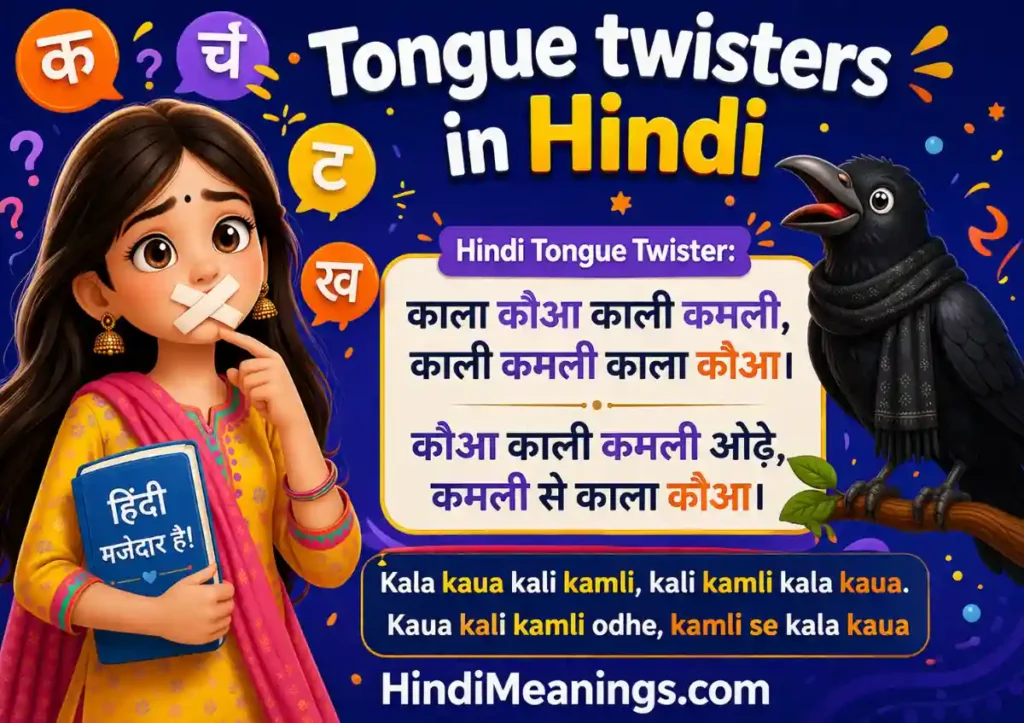
Hindi Tongue Twister:
काला कौआ काली कमली, काली कमली काला कौआ।
कौआ काली कमली ओढ़े, कमली से काला कौआ।
English Transliteration:
Kala kaua kali kamli, kali kamli kala kaua.
Kaua kali kamli odhe, kamli se kala kaua.
Explanation (हिंदी में): इस टंग ट्विस्टर में काला कौआ और काली कमली (काले रंग की शॉल) का बार-बार ज़िक्र होता है। “क” अक्षर की पुनरावृत्ति इसे बोलने में बहुत मुश्किल बनाती है।
English Explanation: This tongue twister repeats the “K” sound using “kaua” (crow) and “kamli” (black shawl). The repetition of similar-sounding words makes this one of the most popular difficult Hindi tongue twisters for kids and adults alike. Try saying it 5 times fast!
2. पके पेड़ पर पका पपीता (Pake Ped Par Paka Papita)
Hindi Tongue Twister:
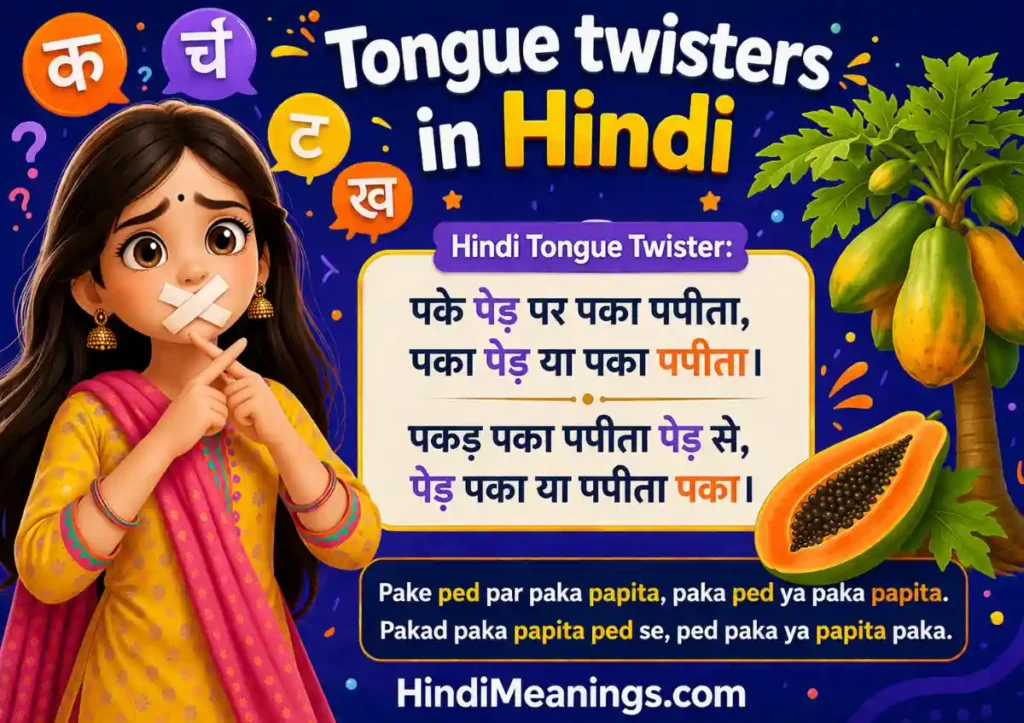
पके पेड़ पर पका पपीता, पका पेड़ या पका पपीता।
पकड़ पका पपीता पेड़ से, पेड़ पका या पपीता पका।
English Transliteration:
Pake ped par paka papita, paka ped ya paka papita.
Pakad paka papita ped se, ped paka ya papita paka.
Explanation (हिंदी में): इस वाक्य में “प” अक्षर की बार-बार आवृत्ति होती है। पका पपीता, पेड़ — ये शब्द मिलकर जीभ को लड़खड़ा देते हैं।
English Explanation: This is a classic Hindi tongue twister with P sound. “Paka papita” means “ripe papaya” and “ped” means tree. The constant repetition of the “P” sound is what makes this a truly dirty tongue twister in Hindi — difficult even for native speakers!
3. चंदू के चाचा ने चंदू की चाची को (Chandu Ke Chacha)
Hindi Tongue Twister:
चंदू के चाचा ने चंदू की चाची को चाँदनी रात में चाँदी की चम्मच से चटनी चटाई।
English Transliteration:
Chandu ke chacha ne Chandu ki chachi ko chandni raat mein chandi ki chamach se chatni chatai.
Explanation (हिंदी में): यह हिंदी का सबसे प्रसिद्ध टंग ट्विस्टर है। “च” की ध्वनि बार-बार आती है जो जीभ को उलझा देती है।
English Explanation: This is arguably the most famous Hindi tongue twister for adults and children. It means “Chandu’s uncle fed Chandu’s aunt chutney with a silver spoon on a moonlit night.” The “Ch” sound is repeated throughout, making this a legendary dirty tongue twister in Hindi. It tests your control over the palatal sounds of Hindi.
4. बाबा बोला बड़ी बात (Baba Bola Badi Baat)
Hindi Tongue Twister:
बाबा बोला बड़ी बात, बड़ी बात बाबा बोला।
बड़े बाबा बोले बोल, बोल बोल बाबा बोला।
English Transliteration:
Baba bola badi baat, badi baat baba bola.
Bade baba bole bol, bol bol baba bola.
Explanation (हिंदी में): “ब” अक्षर की बार-बार आवृत्ति इस टंग ट्विस्टर को कठिन बनाती है। बाबा, बात, बोला — सभी एक जैसे लगते हैं।
English Explanation: This Hindi tongue twister with B sound uses words like “baba” (elder/grandfather), “baat” (talk/word), and “bola” (said). The bilabial “B” sound creates a stutter-like effect that is characteristic of great dirty tongue twisters in Hindi. This is great for speech therapy exercises in Hindi.
5. समझ समझ के समझो समझ (Samajh Samajh Ke Samjho Samajh)
Hindi Tongue Twister:
समझ समझ के समझो समझ, समझ समझना भी एक समझ है।
समझ समझ जो न समझे, वो नासमझ ही समझ है।
English Transliteration:
Samajh samajh ke samjho samajh, samajh samajhna bhi ek samajh hai.
Samajh samajh jo na samjhe, vo nasamajh hi samajh hai.
Explanation (हिंदी में): यह दार्शनिक टंग ट्विस्टर है जिसमें “समझ” शब्द इतनी बार आता है कि अर्थ और उच्चारण दोनों उलझ जाते हैं।
English Explanation: This is a philosophical Hindi tongue twister based on the word “samajh” meaning “understanding.” It translates to: “Understand understanding with understanding — understanding understanding is itself understanding. One who does not understand understanding, that understanding is foolishness.” This is both a mind-bender and a tongue twister in Hindi that challenges both brain and tongue simultaneously.
6. ऊँट ऊँचा, ऊँट की पीठ ऊँची (Oont Ooncha)
Hindi Tongue Twister:
ऊँट ऊँचा, ऊँट की पीठ ऊँची।
ऊँट की पीठ पर ऊँचा ऊँट, ऊँचे ऊँट की ऊँची पीठ।
English Transliteration:
Oont ooncha, oont ki peeth oonchi.
Oont ki peeth par ooncha oont, oonche oont ki oonchi peeth.
Explanation (हिंदी में): ऊँट का ऊँचापन इस टंग ट्विस्टर की खासियत है। “ऊँ” की ध्वनि नाक से निकलती है और इसे तेज़ बोलने पर जीभ फिसल जाती है।
English Explanation: This nasal sound Hindi tongue twister uses “oont” (camel) and “ooncha” (tall/high). The nasal “oon” sound repeated rapidly is very tricky. This is a well-known dirty Hindi tongue twister for adults that tests the nasal resonance in Hindi speech. It means “The camel is tall, the camel’s back is tall — a tall camel on a camel’s back, the tall camel’s tall back.”
7. तोता ताते ताल में (Tota Tate Taal Mein)
Hindi Tongue Twister:
तोता ताते ताल में, ताल में तोता ताता।
ताते ताते तोता बोला, तोते ने तान छेड़ी।
English Transliteration:
Tota tate taal mein, taal mein tota taata.
Tate tate tota bola, tote ne taan chedi.
Explanation (हिंदी में): इसमें “त” और “ट” की ध्वनियाँ मिलकर जीभ को उलझाती हैं। तोता (तोता) और ताल (झील/तालाब) से बनी यह पंक्तियाँ बोलने में बहुत कठिन हैं।
English Explanation: This is one of the most challenging T-sound Hindi tongue twisters. “Tota” means parrot, “taal” means pond/rhythm, and “taan” means musical note. The mix of “T” and “Ta” sounds in quick succession makes this a genuinely dirty tongue twister in Hindi. It is often used in Hindi speech training exercises. Try saying it 3 times without a mistake!
8. खड़ी खिड़की खुली खिड़की (Khadi Khidki Khuli Khidki)
Hindi Tongue Twister:
खड़ी खिड़की खुली खिड़की, खुली खिड़की खड़ी खिड़की।
खड़ी खुली या खुली खड़ी, खिड़की खड़ी है या खुली?
English Transliteration:
Khadi khidki khuli khidki, khuli khidki khadi khidki.
Khadi khuli ya khuli khadi, khidki khadi hai ya khuli?
Explanation (हिंदी में): “ख” और “खि” की आवाज़ें मिलकर इसे बोलने में बेहद कठिन बना देती हैं। “खड़ी” (standing/vertical) और “खुली” (open) दोनों एक जैसे सुनाई देते हैं।
English Explanation: This is a superb Kh-sound Hindi tongue twister. “Khidki” means window, “khadi” means standing/vertical, and “khuli” means open. The meaning is: “A standing open window, an open standing window — is it standing-open or open-standing? Is the window standing or open?” This is among the best dirty tongue twisters in Hindi for confusing even fluent Hindi speakers.
Tips to Master Hindi Tongue Twisters (टंग ट्विस्टर कैसे बोलें?)
Here are some practical tips to master these difficult Hindi tongue twisters:
- Start Slowly: First read the tongue twister slowly and understand its meaning. पहले धीरे-धीरे पढ़ें।
- Repeat 3 Times: Try to say it 3 times in a row without stopping. तीन बार लगातार दोहराएं।
- Record Yourself: Use your phone to record your voice and listen back. अपनी आवाज़ रिकॉर्ड करके सुनें।
- Exaggerate Sounds: Emphasize the tricky consonants during practice. मुश्किल अक्षरों पर ज़ोर दें।
- Practice Daily: 5 minutes daily practice improves your Hindi diction significantly. रोज़ 5 मिनट अभ्यास करें।
Benefits of Practicing Hindi Tongue Twisters (फायदे)
Practicing tongue twisters in Hindi regularly has many benefits:
- Improves Hindi pronunciation and diction
- Helps children learn new Hindi words playfully
- Useful for speech therapy in Hindi-speaking communities
- Reduces stammering and improves fluency
- Great warm-up exercise for singers and actors
- Builds vocabulary through repeated exposure to rich Hindi words
If you want to improve your overall Hindi vocabulary along with pronunciation, check out our guides on Daily English Words with Hindi Meaning and Hindi Numbers in Words 1 to 50.
Tongue Twisters in Different Indian Languages
India is a land of many languages, and tongue twisters exist across all of them. While Hindi tongue twisters are popular in North India, Tamil, Telugu, Marathi, and Bengali also have their own traditional tongue twisters used in schools and cultural programs. Hindi being the most widely spoken language in India has the richest collection of tongue twisters that span from simple children’s rhymes to highly complex phonetic challenges.
For more fascinating Hindi language content, you can explore resources from the Hindi Bhasha portal and BBC Hindi which offer excellent language learning material.
Frequently Asked Questions (FAQs)
Q1. What does “dirty tongue twister in Hindi” mean?
“Dirty” here refers to tongue twisters that are so phonetically difficult that they make your tongue “slip” or stumble badly. They are not offensive — they are simply the most challenging Hindi tongue twisters that even native speakers find hard to say quickly.
Q2. Which is the hardest tongue twister in Hindi?
The “Chandu ke chacha ne Chandu ki chachi ko chandni raat mein chandi ki chamach se chatni chatai” is widely considered the hardest Hindi tongue twister due to its rapid “Ch” sound repetition.
Q3. Are Hindi tongue twisters good for children?
Yes! Hindi tongue twisters are excellent for children as they improve pronunciation, expand vocabulary, and make language learning fun. Teachers use them as classroom activities regularly.
Q4. How do tongue twisters help in speech therapy?
Speech therapists use tongue twisters to isolate specific phonetic sounds and help patients practice them repeatedly. Hindi tongue twisters are especially useful for addressing challenges with retroflex and aspirated consonant sounds.
Q5. Can tongue twisters help improve English pronunciation too?
Absolutely. While these are Hindi tongue twisters, the habit of practicing difficult phonetic patterns transfers to any language. Many Hindi learners also practice public speaking techniques from Toastmasters to combine tongue twister practice with overall speech improvement.
Conclusion (निष्कर्ष)
These 8 dirty tongue twisters in Hindi with explanation are a perfect mix of fun, language learning, and phonetic challenge. Whether you are a student trying to improve your Hindi pronunciation, a parent looking for educational games for your child, or simply someone who enjoys word games, these Hindi tongue twisters will keep you entertained and linguistically challenged.
bookmark this page, practice daily, and share these मज़ेदार हिंदी टंग ट्विस्टर with your friends and family. जितना ज़्यादा अभ्यास करेंगे, उतना ही आपकी हिंदी और स्पष्ट होगी!
You might also enjoy reading our article on Short Story About Friendship in Hindi for more Hindi language enrichment.