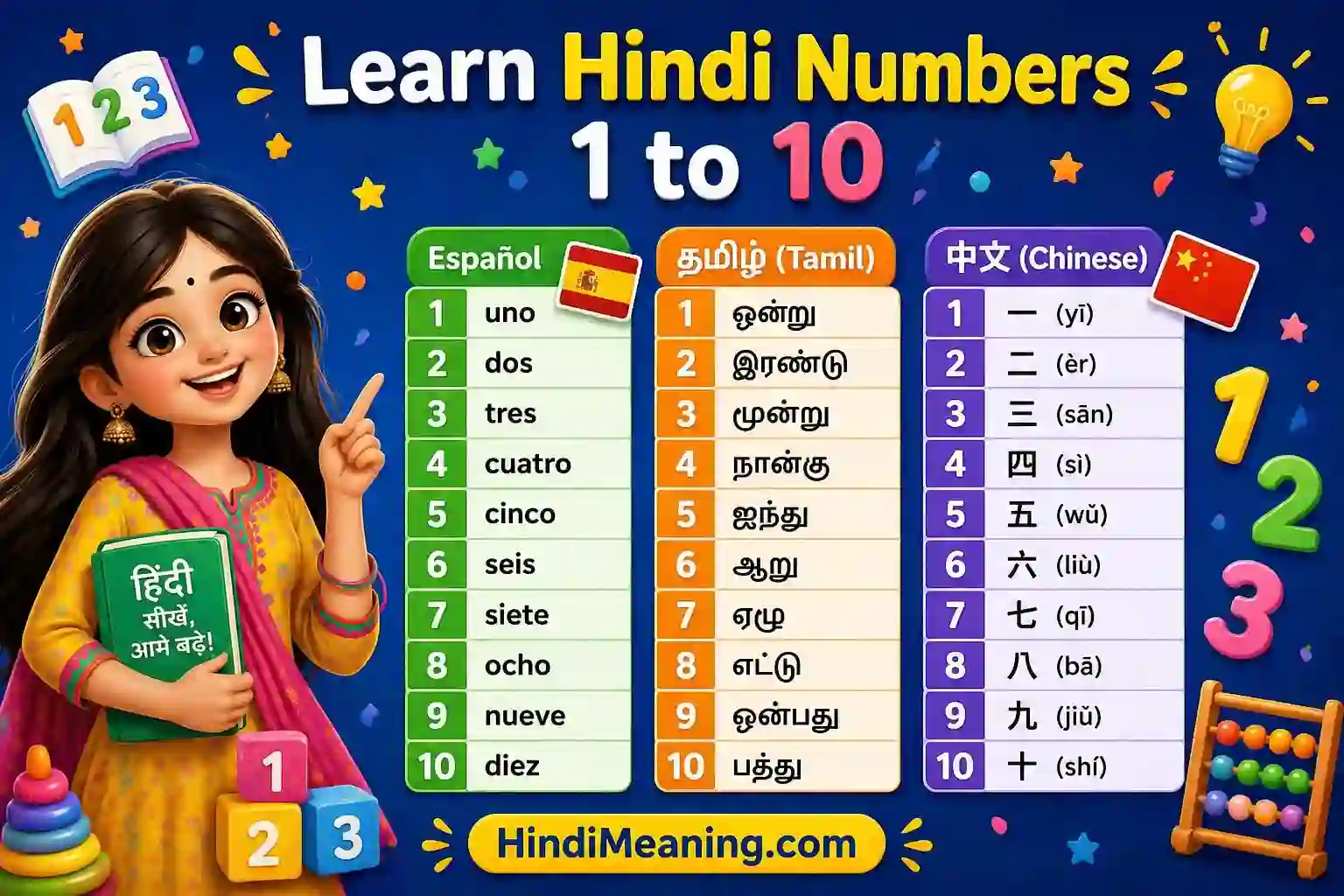
Learn Hindi Numbers 1 to 10 is one of the most searched topics by students, parents, language learners, and travelers worldwide. Whether you speak Spanish, Tamil, Chinese, or any other language — understanding Hindi numbers opens a gateway to one of the world’s richest cultures. In this comprehensive guide, you will learn Hindi numbers 1 to 10 along with their equivalents in Spanish, Tamil, and Chinese, making this a truly multilingual numbers resource.
Why Learn Hindi Numbers 1 to 10?
Hindi is spoken by over 600 million people globally and is the official language of India. Learning Hindi numbers 1 to 10 is the first essential step for anyone who wants to communicate in Hindi — whether for travel, business, education, or simply cultural curiosity. Numbers are used in every aspect of daily life: shopping, telling time, dates, phone numbers, and more. Once you master the basics, the rest of the language becomes much easier to approach.
Learn Hindi Numbers 1 to 10 – Complete Table with Pronunciation
The table below shows all Hindi numbers from 1 to 10 with their Devanagari script, Roman transliteration, and English translation. This is your go-to reference when you want to learn Hindi numbers 1 to 10 quickly and accurately.
| Number | Devanagari | Hindi Word | Pronunciation | English |
|---|---|---|---|---|
| 1 | १ | एक | Ek | One |
| 2 | २ | दो | Do | Two |
| 3 | ३ | तीन | Teen | Three |
| 4 | ४ | चार | Chaar | Four |
| 5 | ५ | पाँच | Paanch | Five |
| 6 | ६ | छह | Chhah | Six |
| 7 | ७ | सात | Saat | Seven |
| 8 | ८ | आठ | Aath | Eight |
| 9 | ९ | नौ | Nau | Nine |
| 10 | १० | दस | Das | Ten |
Hindi Numbers 1 to 10 in Spanish (Números Hindi del 1 al 10 en Español)
For Spanish speakers looking to learn Hindi numbers 1 to 10, this section provides a side-by-side comparison. Spanish and Hindi both have deeply phonetic systems, which makes the transition easier than you might expect. Below is a full comparison table with pronunciation tips for Spanish learners.
| Number | Hindi Word | Hindi Pronunciation | Spanish Word | Spanish Pronunciation |
|---|---|---|---|---|
| 1 | एक | Ek | Uno | OO-no |
| 2 | दो | Do | Dos | Dos |
| 3 | तीन | Teen | Tres | Tres |
| 4 | चार | Chaar | Cuatro | KWAH-tro |
| 5 | पाँच | Paanch | Cinco | SEEN-ko |
| 6 | छह | Chhah | Seis | Sace |
| 7 | सात | Saat | Siete | SYEH-teh |
| 8 | आठ | Aath | Ocho | OH-cho |
| 9 | नौ | Nau | Nueve | NWEH-beh |
| 10 | दस | Das | Diez | Dyess |
A fun tip for Spanish learners: Hindi “Do” (दो) sounds similar to Spanish “Dos”, and Hindi “Teen” (तीन) gives the same vibe as “Tres” — both meaning three! This makes it a fun and engaging process to learn Hindi numbers 1 to 10 if you already know Spanish. For more multilingual comparisons, check out this authoritative resource at Omniglot Hindi Numbers.
Hindi Numbers 1 to 10 in Tamil (தமிழில் இந்தி எண்கள் 1 முதல் 10)
Tamil is one of the oldest classical languages in the world, spoken by over 80 million people. For Tamil speakers, comparing Hindi numbers can be a fascinating linguistic exercise. Both Hindi and Tamil have ancient roots and rich number systems. Here is how Hindi numbers 1 to 10 compare with Tamil numbers:
| Number | Hindi Word | Hindi Pronunciation | Tamil Word | Tamil Pronunciation |
|---|---|---|---|---|
| 1 | एक | Ek | ஒன்று | Ondru |
| 2 | दो | Do | இரண்டு | Irandu |
| 3 | तीन | Teen | மூன்று | Moondru |
| 4 | चार | Chaar | நான்கு | Naangu |
| 5 | पाँच | Paanch | ஐந்து | Ainthu |
| 6 | छह | Chhah | ஆறு | Aaru |
| 7 | सात | Saat | ஏழு | Ezhu |
| 8 | आठ | Aath | எட்டு | Ettu |
| 9 | नौ | Nau | ஒன்பது | Onbadu |
| 10 | दस | Das | பத்து | Pathu |
Both Hindi and Tamil have completely independent number systems with no direct phonetic overlap — which is why learning both is a rewarding challenge. Tamil speakers in India often switch between Tamil and Hindi in daily conversation, making it especially valuable to learn Hindi numbers 1 to 10 alongside your mother tongue.
Hindi Numbers 1 to 10 in Chinese (用中文学印地语数字 1 到 10)
Chinese (Mandarin) is the most widely spoken language in the world, and Chinese learners are increasingly interested in Hindi. For Mandarin speakers, both languages use completely different scripts — but the logic of numbers makes it simpler to bridge the gap. Here is a comparison of Hindi numbers 1 to 10 with Chinese Mandarin numbers:
| Number | Hindi Word | Hindi Pronunciation | Chinese (汉字) | Pinyin | Chinese Pronunciation |
|---|---|---|---|---|---|
| 1 | एक | Ek | 一 | Yī | Ee |
| 2 | दो | Do | 二 | Èr | Ar |
| 3 | तीन | Teen | 三 | Sān | San |
| 4 | चार | Chaar | 四 | Sì | Ss |
| 5 | पाँच | Paanch | 五 | Wǔ | Woo |
| 6 | छह | Chhah | 六 | Liù | Lyoh |
| 7 | सात | Saat | 七 | Qī | Chee |
| 8 | आठ | Aath | 八 | Bā | Bah |
| 9 | नौ | Nau | 九 | Jiǔ | Jyoh |
| 10 | दस | Das | 十 | Shí | Shh |
Chinese numbers are famously logical — once you know 1–10, the entire system up to 100 is learnable within minutes. Hindi shares this elegance, where higher numbers follow predictable patterns. If you are a Chinese learner trying to learn Hindi numbers 1 to 10, the structured repetition used in Chinese language learning (flashcards, tone practice, repetition) works beautifully for Hindi too.
Multilingual Number Comparison Chart – Hindi, Spanish, Tamil, and Chinese
Here is a quick all-in-one multilingual table so you can compare all four languages at once. This is especially useful for teachers, linguists, and multilingual learners who want to learn Hindi numbers 1 to 10 in the context of global languages.
| No. | Hindi | Spanish | Tamil | Chinese (Pinyin) |
|---|---|---|---|---|
| 1 | एक (Ek) | Uno | Ondru | Yī (一) |
| 2 | दो (Do) | Dos | Irandu | Èr (二) |
| 3 | तीन (Teen) | Tres | Moondru | Sān (三) |
| 4 | चार (Chaar) | Cuatro | Naangu | Sì (四) |
| 5 | पाँच (Paanch) | Cinco | Ainthu | Wǔ (五) |
| 6 | छह (Chhah) | Seis | Aaru | Liù (六) |
| 7 | सात (Saat) | Siete | Ezhu | Qī (七) |
| 8 | आठ (Aath) | Ocho | Ettu | Bā (八) |
| 9 | नौ (Nau) | Nueve | Onbadu | Jiǔ (九) |
| 10 | दस (Das) | Diez | Pathu | Shí (十) |
Tips to Learn Hindi Numbers 1 to 10 Fast
Here are some proven strategies to help you learn Hindi numbers 1 to 10 quickly, whether you are a beginner, a child, or a multilingual learner:
- Use Flashcards: Write the Devanagari numeral on one side and the English/Spanish/Tamil/Chinese equivalent on the other. Daily review builds memory fast.
- Practice with Songs: Hindi counting rhymes like “Ek Do Teen Char” are a fun and effective way for kids and adults alike to memorize numbers.
- Watch Hindi Videos: Watching short YouTube videos where native speakers use numbers in context helps with pronunciation and recall.
- Pair with Your Language: If you speak Spanish, compare Hindi “Do” with Spanish “Dos.” If you speak Chinese, notice how both languages use a very logical structure for larger numbers.
- Write Daily: Practice writing the Devanagari numerals १, २, ३ every day. Muscle memory accelerates learning significantly. You can find printable practice sheets on HindiMeanings.com Hindi Numbers.
Related Hindi Learning Resources
Once you have mastered how to learn Hindi numbers 1 to 10, here are the next steps on your Hindi learning journey. Check out these related articles on our site:
- Hindi Numbers 1 to 100 — Extend your counting knowledge from 10 to 100.
- Hindi Meanings Homepage — Your complete resource for learning Hindi words, meanings, and more.
Frequently Asked Questions (FAQs)
Q1: What is the best way to learn Hindi numbers 1 to 10?
The best way to learn Hindi numbers 1 to 10 is through a combination of flashcards, pronunciation practice, writing Devanagari numerals, and listening to native Hindi speakers. Using comparative tables with your own language (Spanish, Tamil, or Chinese) can make the learning process even faster.
Q2: How do you say 1 to 10 in Hindi?
In Hindi, 1 to 10 are: एक (Ek), दो (Do), तीन (Teen), चार (Chaar), पाँच (Paanch), छह (Chhah), सात (Saat), आठ (Aath), नौ (Nau), दस (Das).
Q3: Are Hindi numbers similar to Spanish, Tamil, or Chinese numbers?
Not phonetically — Hindi, Spanish, Tamil, and Chinese all have completely independent number words. However, all four languages share the same Arabic numeral system (1, 2, 3…) in everyday writing. Hindi additionally uses Devanagari numerals (१, २, ३…) in formal and educational contexts.
Q4: How long does it take to learn Hindi numbers 1 to 10?
With consistent daily practice of 10–15 minutes, most learners can confidently learn Hindi numbers 1 to 10 within 2–3 days. Using this multilingual guide alongside flashcards and audio practice can cut that time in half.
Conclusion
Learning numbers is always the first step in any new language — and Hindi is no exception. This guide has helped you learn Hindi numbers 1 to 10 alongside their Spanish, Tamil, and Chinese equivalents, making it one of the most comprehensive multilingual number guides available. Whether you are a student, a traveler, a teacher, or a language enthusiast, mastering these foundational numbers will open doors to a rich and rewarding linguistic journey. Keep practicing, stay consistent, and visit HindiMeanings.com regularly for more Hindi learning resources.