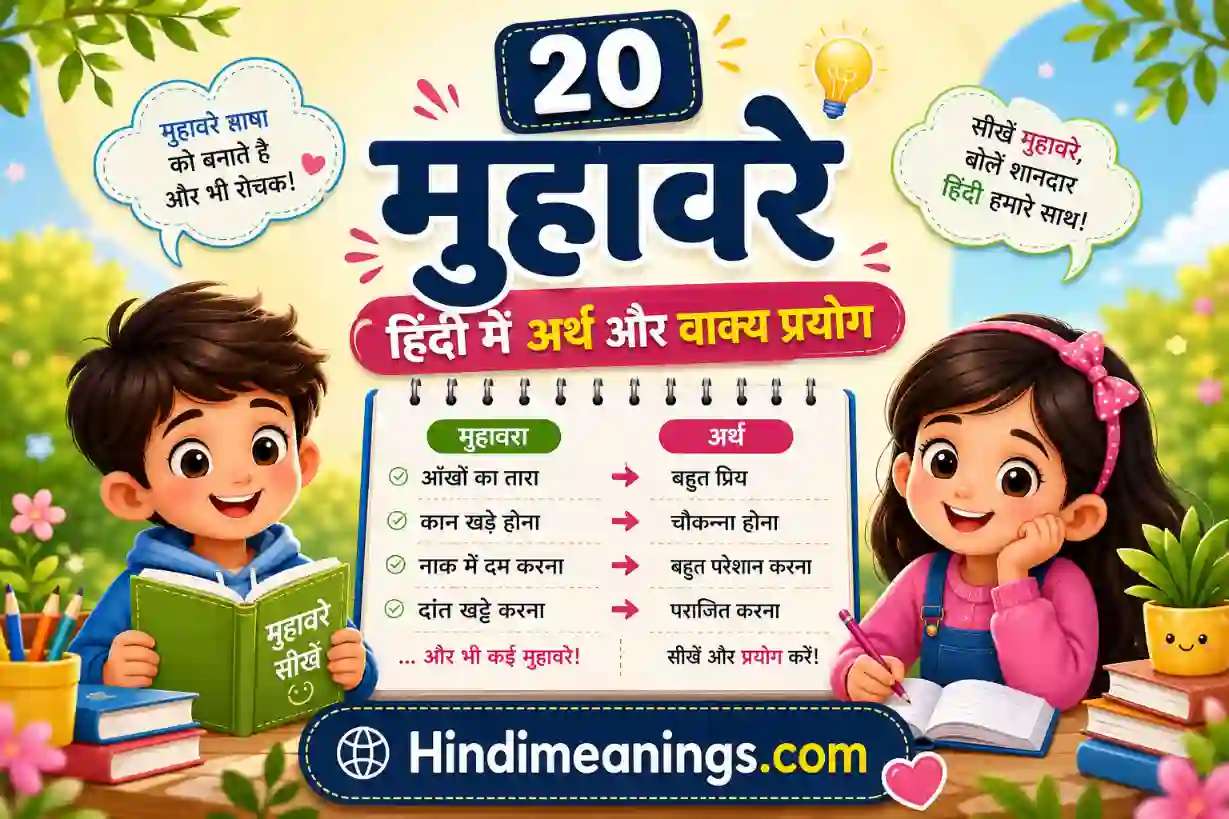
20 Muhavare in Hindi सीखना हिंदी भाषा को बेहतर, प्रभावशाली और रोचक बनाने का एक आसान तरीका है। मुहावरे केवल शब्दों का समूह नहीं होते, बल्कि ये भाषा में भाव, शैली और गहराई जोड़ते हैं। इस लेख में 20 लोकप्रिय मुहावरे उनके अर्थ और आसान वाक्य प्रयोग के साथ दिए गए हैं, ताकि विद्यार्थी, प्रतियोगी परीक्षा की तैयारी करने वाले और हिंदी सीखने वाले सभी लोग इन्हें आसानी से समझ सकें।
मुहावरा क्या होता है? (What is an Idiom?)
मुहावरा एक ऐसा वाक्यांश होता है जिसका अर्थ उसके शब्दों के सीधे अर्थ से अलग होता है। जब किसी बात को रोचक, प्रभावशाली और संक्षिप्त तरीके से कहना हो, तब मुहावरों का उपयोग किया जाता है। हिंदी व्याकरण में मुहावरे भाषा की सुंदरता बढ़ाते हैं और बोलचाल को अधिक स्वाभाविक बनाते हैं।
20 Muhavare in Hindi-pdf-Download from Here20 Muhavare in Hindi (20 Idioms in Hindi)
नीचे 20 महत्वपूर्ण मुहावरे, उनके अर्थ और वाक्य प्रयोग दिए गए हैं। ये मुहावरे सामान्य हिंदी लेखन, स्कूल परीक्षा और spoken Hindi में भी बहुत उपयोगी हैं।
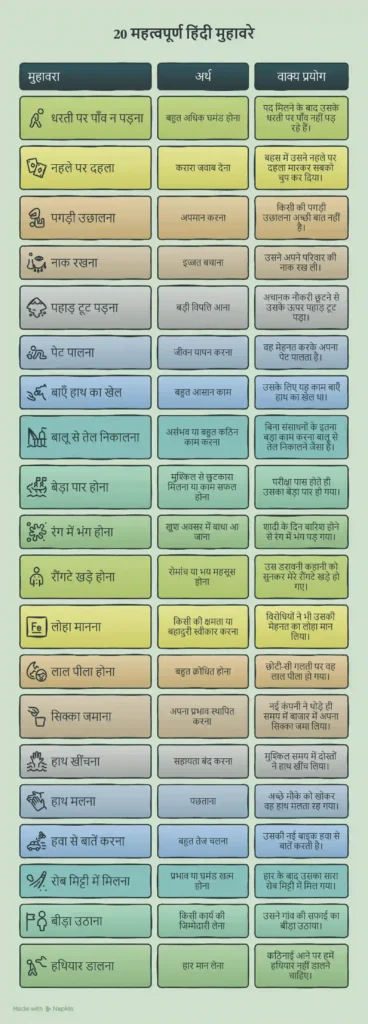
- धरती पर पाँव न पड़ना – बहुत अधिक घमंड होना।
वाक्य प्रयोग: पद मिलने के बाद उसके धरती पर पाँव नहीं पड़ रहे हैं। - नहले पर दहला – करारा जवाब देना।
वाक्य प्रयोग: बहस में उसने नहले पर दहला मारकर सबको चुप कर दिया। - पगड़ी उछालना – अपमान करना।
वाक्य प्रयोग: किसी की पगड़ी उछालना अच्छी बात नहीं है। - नाक रखना – इज्जत बचाना।
वाक्य प्रयोग: उसने अपने परिवार की नाक रख ली। - पहाड़ टूट पड़ना – बड़ी विपत्ति आना।
वाक्य प्रयोग: अचानक नौकरी छूटने से उसके ऊपर पहाड़ टूट पड़ा। - पेट पालना – जीवन यापन करना।
वाक्य प्रयोग: वह मेहनत करके अपना पेट पालता है। - बाएँ हाथ का खेल – बहुत आसान काम।
वाक्य प्रयोग: उसके लिए यह काम बाएँ हाथ का खेल था। - बालू से तेल निकालना – असंभव या बहुत कठिन काम करना।
वाक्य प्रयोग: बिना संसाधनों के इतना बड़ा काम करना बालू से तेल निकालने जैसा है। - बेड़ा पार होना – मुश्किल से छुटकारा मिलना या काम सफल होना।
वाक्य प्रयोग: परीक्षा पास होते ही उसका बेड़ा पार हो गया। - रंग में भंग होना – खुश अवसर में बाधा आ जाना।
वाक्य प्रयोग: शादी के दिन बारिश होने से रंग में भंग पड़ गया। - रौंगटे खड़े होना – रोमांच या भय महसूस होना।
वाक्य प्रयोग: उस डरावनी कहानी को सुनकर मेरे रौंगटे खड़े हो गए। - लोहा मानना – किसी की क्षमता या बहादुरी स्वीकार करना।
वाक्य प्रयोग: विरोधियों ने भी उसकी मेहनत का लोहा मान लिया। - लाल पीला होना – बहुत क्रोधित होना।
वाक्य प्रयोग: छोटी-सी गलती पर वह लाल पीला हो गया। - सिक्का जमाना – अपना प्रभाव स्थापित करना।
वाक्य प्रयोग: नई कंपनी ने थोड़े ही समय में बाजार में अपना सिक्का जमा लिया। - हाथ खींचना – सहायता बंद करना।
वाक्य प्रयोग: मुश्किल समय में दोस्तों ने हाथ खींच लिया। - हाथ मलना – पछताना।
वाक्य प्रयोग: अच्छे मौके को खोकर वह हाथ मलता रह गया। - हवा से बातें करना – बहुत तेज चलना।
वाक्य प्रयोग: उसकी नई बाइक हवा से बातें करती है। - रोब मिट्टी में मिलना – प्रभाव या घमंड खत्म होना।
वाक्य प्रयोग: हार के बाद उसका सारा रोब मिट्टी में मिल गया। - बीड़ा उठाना – किसी कार्य की जिम्मेदारी लेना।
वाक्य प्रयोग: उसने गांव की सफाई का बीड़ा उठाया। - हथियार डालना – हार मान लेना।
वाक्य प्रयोग: कठिनाई आने पर हमें हथियार नहीं डालने चाहिए।
मुहावरों का वाक्य प्रयोग क्यों ज़रूरी है? (Why Sentence Use Matters)
केवल मुहावरे और उनके अर्थ याद कर लेना पर्याप्त नहीं होता। यदि आप उनके साथ सही वाक्य प्रयोग भी सीखते हैं, तो आप उन्हें लिखने, बोलने और परीक्षा में उपयोग करने में अधिक आत्मविश्वास महसूस करते हैं। वाक्य प्रयोग से यह भी समझ आता है कि मुहावरा किस स्थिति में इस्तेमाल किया जाता है।
20 Muhavare in Hindi याद करने के आसान तरीके (Easy Ways to Remember 20 Idioms)
- मुहावरों को अर्थ के साथ एक ही बार में याद करें।
- हर मुहावरे का एक छोटा वाक्य स्वयं बनाएं।
- इन्हें रोज़मर्रा की बातचीत में प्रयोग करने की कोशिश करें।
- मुहावरों को विषय के अनुसार बाँटकर पढ़ें, जैसे घमंड, गुस्सा, सफलता, दुख आदि।
- बार-बार दोहराने से याददाश्त मजबूत होती है।
छात्रों के लिए मुहावरे कैसे उपयोगी हैं? (How Idioms Help Students)
मुहावरे स्कूल की परीक्षाओं में अक्सर पूछे जाते हैं। हिंदी निबंध, पत्र-लेखन, अनुच्छेद लेखन और व्याकरण के प्रश्नों में इनका उपयोग आपके उत्तर को बेहतर बनाता है। इसके अलावा, प्रतियोगी परीक्षाओं में भी मुहावरों का ज्ञान बहुत काम आता है।
मुहावरे और लोकोक्तियाँ में अंतर (Difference Between Idioms and Proverbs)
मुहावरा और लोकोक्ति दोनों हिंदी भाषा के महत्वपूर्ण अंग हैं, लेकिन दोनों में अंतर होता है। मुहावरा किसी विशेष भाव या स्थिति को संक्षेप में व्यक्त करता है, जबकि लोकोक्ति एक पूर्ण कथन या सीख देने वाली बात होती है। मुहावरा अक्सर वाक्य के भीतर प्रयोग होता है, लेकिन लोकोक्ति का अर्थ प्रायः स्वतंत्र रूप से भी समझा जा सकता है।
अभ्यास के लिए छोटे प्रश्न (Quick Practice Questions)
- कौन-सा मुहावरा घमंड के लिए प्रयोग होता है?
- कौन-सा मुहावरा हार मानने के अर्थ में आता है?
- कौन-सा मुहावरा बहुत आसान काम के लिए प्रयोग होता है?
- कौन-सा मुहावरा पछताने के अर्थ में है?
निष्कर्ष (Conclusion)
20 Muhavare in Hindi का अभ्यास हिंदी भाषा को अधिक प्रभावशाली और सुंदर बनाने में मदद करता है। यदि आप इन मुहावरों को अर्थ और वाक्य प्रयोग के साथ याद करेंगे, तो आपका शब्द-भंडार मजबूत होगा और लिखने-बोलने की शैली बेहतर बनेगी। नियमित अभ्यास से इनका उपयोग आसान हो जाता है और परीक्षा में भी अच्छे अंक पाने में मदद मिलती है।
अक्सर पूछे जाने वाले प्रश्न (FAQs)
मुहावरा किसे कहते हैं? (What is called an idiom?)
मुहावरा ऐसा वाक्यांश होता है जिसका अर्थ उसके शब्दों के सामान्य अर्थ से अलग होता है।
20 Muhavare in Hindi क्यों पढ़ने चाहिए? (Why should we learn 20 Muhavare in Hindi?)
इनसे हिंदी भाषा की समझ, लेखन कौशल और परीक्षा की तैयारी बेहतर होती है।
क्या मुहावरे केवल परीक्षा के लिए उपयोगी हैं? (Are idioms useful only for exams?)
नहीं, मुहावरे बोलचाल, लेखन और अभिव्यक्ति को भी अधिक प्रभावशाली बनाते हैं।
मुहावरे याद करने का सबसे अच्छा तरीका क्या है? (Best way to remember idioms)
अर्थ, वाक्य प्रयोग और नियमित दोहराव के साथ मुहावरे याद करना सबसे अच्छा तरीका है।
Frequently Asked Questions on “20 Muhavare in Hindi”
Meaning & Definition
- “मुहावरा” किसे कहते हैं? (What is an idiom?)
Answer: A मुहावरा is a phrase or expression whose meaning is different from the literal meaning of its individual words. - “मुहावरा” और “लोकोक्ति” में क्या अंतर है? (What is the difference between an idiom and a proverb?)
Answer: Idioms are phrases with figurative meanings used in sentences. Proverbs are complete, independent statements that offer advice or a general truth. - हिंदी में कितने मुहावरे हैं? (How many idioms are there in Hindi?)
Answer: There isn’t a fixed number, as the language is constantly evolving. However, hundreds of commonly used idioms are documented in various grammar books and resources.
Common Idioms & Their Meanings
- ‘अंगूठा दिखाना’ मुहावरे का क्या अर्थ है? (What is the meaning of the idiom ‘Angutha Dikhana’?)
Answer: This idiom means to refuse or deceive someone at the last moment, often to back out of a commitment. - ‘आस्तीन का साँप’ मुहावरे का क्या अर्थ है? (What is the meaning of the idiom ‘Aasteen ka Saamp’?)
Answer: It refers to a treacherous friend or a person who appears friendly but is deceitful and harmful. - ‘नौ-दो ग्यारह होना’ मुहावरे का क्या अर्थ है? (What is the meaning of the idiom ‘Nau-Do Gyarah Hona’?)
Answer: This idiom means to run away or escape quickly, usually to avoid a difficult situation. - ‘अपने पैर पर कुल्हाड़ी मारना’ मुहावरे का क्या अर्थ है? (What is the meaning of the idiom ‘Apne Paon par Kulhadi Marna’?)
Answer: It means to harm oneself by one’s own actions. - ‘एक और एक ग्यारह होना’ मुहावरे का क्या अर्थ है? (What is the meaning of the idiom ‘Ek aur Ek Gyarah Hona’?)
Answer: This idiom signifies that there is strength in unity.
Usage & Application
- ‘मुहावरे’ का वाक्य में सही प्रयोग कैसे करें? (How to use an idiom correctly in a sentence?)
Answer: Use the idiom in a context where its figurative meaning is clear, ensuring it fits the situation naturally. For example, “पुलिस को देखते ही चोर नौ-दो ग्यारह हो गया।” - क्या ‘मुहावरे’ का शाब्दिक अर्थ लेना चाहिए? (Should the literal meaning of an idiom be taken?)
Answer: No. The literal meaning is almost always different. The figurative meaning should be understood and used. - ‘पढ़ाई में मेहनत कर मैं ………… हो सकता हूँ।’ – रिक्त स्थान के लिए उचित मुहावरा क्या है? (What is the appropriate idiom to fill in the blank: ‘Padhai mein mehnat kar main ……… ho sakta hoon’?)
Answer: पैरों पर खड़ा होना (to become self-reliant). - ‘विपत्ति में उसकी अक्ल …………’ – रिक्त स्थान के लिए उचित मुहावरा क्या है? (What is the appropriate idiom to fill in the blank: ‘Vipatti mein uski aql …………’?)
Answer: चकरा जाना (to become confused or lose one’s wits during a crisis). - ‘गरीब माँ-बाप अपना ………… कर बच्चों को पढ़ाते हैं।’ – रिक्त स्थान के लिए उचित मुहावरा क्या है? (What is the appropriate idiom to fill in the blank: ‘Garib maa-baap apna ………… kar bachchon ko padhate hain’?)
Answer: पेट काटकर (to make a sacrifice, even going hungry for the sake of their children). - ‘मुकेश ने उसे जितना रुपया उधार दिया था वह सब हज़म कर गया।’ – इस वाक्य में रेखांकित वाक्यांश के लिए उचित मुहावरा क्या है? (What is the correct idiom for the underlined phrase in the sentence: ‘Mukesh ne use jitna rupaya udhar diya tha vah sab hazam kar gaya’?)
Answer: डकार जाना (to consume or embezzle something). - ‘मेरे दोस्त ने मुझे धोखा दिया, वह तो ……… निकला।’ – रिक्त स्थान के लिए उचित मुहावरा क्या है? (What is the appropriate idiom to fill in the blank: ‘Mere dost ne mujhe dhokha diya, vah toh ……… nikla’?)
Answer: आस्तीन का साँप (a treacherous or deceitful person).
Idioms by Category
- ‘शरीर के अंगों’ से जुड़े कुछ मुहावरे क्या हैं? (What are some idioms related to body parts?)
Answer: Examples include:- आँखों का तारा (very dear)
- नाक में दम करना (to harass)
- मुँह मीठा करना (to celebrate or eat something sweet)
- ‘पशु-पक्षियों’ से जुड़े कुछ मुहावरे क्या हैं? (What are some idioms related to animals and birds?)
Answer: Examples include:
Usage & Application
“20 मुहावरे” सीखने का सबसे अच्छा तरीका क्या है? (What is the best way to learn ’20 Muhavare’?)
Answer: Practice by reading, listening to, and using them in sentences. Listening to audio resources like MCQs multiple times can also be very effective for memorization
क्या ‘मुहावरे’ का प्रयोग केवल हिंदी व्याकरण में ही होता है? (Are idioms used only in Hindi grammar?)
Answer: No. Idioms are used in spoken and written Hindi to make the language more expressive, vivid, and interesting.
प्रतियोगी परीक्षाओं में ‘मुहावरे’ से किस प्रकार के प्रश्न पूछे जाते हैं? (What type of questions are asked about idioms in competitive exams?)
Answer: Questions are usually multiple-choice, asking for the meaning of an idiom, or to choose the correct idiom to fill in a blank.