
The Evening That Changed Everything
The sun was setting over the small village of Rampur, painting the sky in shades of orange and gold. Seven-year-old Aarav and his nine-year-old sister Priya sat cross-legged on the cool floor of their grandfather’s courtyard, eagerly waiting for their favorite part of the day – story time with Dadaji.
“Dadaji, Dadaji!” Aarav called out excitedly as their grandfather emerged from the house carrying a glass of water. “Today our teacher taught us a Sanskrit phrase – Atithi Devo Bhava. She said it means ‘the guest is God,’ but I don’t understand. How can a guest be God?”

Grandfather smiled warmly, his wrinkled face lighting up with wisdom. He settled down on his wooden chair, adjusted his white dhoti, and looked at his curious grandchildren with twinkling eyes.
“Ah, my dear children,” he began in his gentle voice, “this is not just a phrase – it is the very heart of our Indian culture and Hindu traditions. Let me tell you a story that my grandfather once told me, a story that will help you understand why we say Atithi Devo Bhava.”

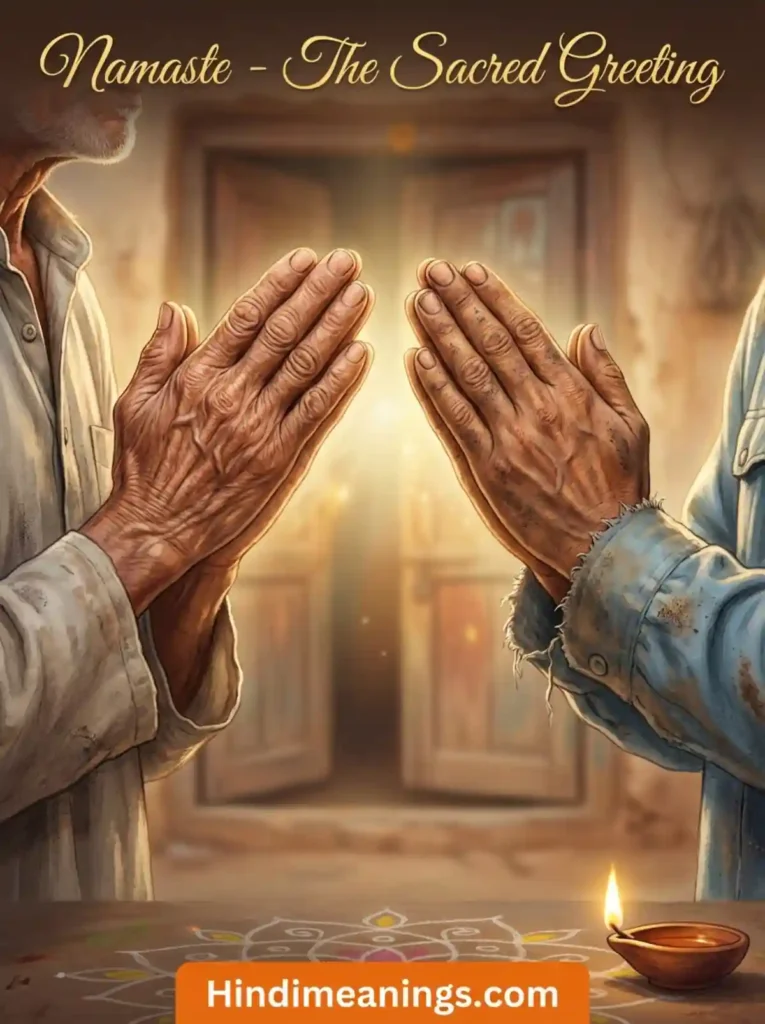
The Story of the Poor Brahmin and the Mysterious Traveler
“Many, many years ago,” Grandfather began, “in this very village of Rampur, there lived a poor Brahmin named Gopal. He was so poor that some days, he and his wife Lakshmi barely had enough food for themselves. But Gopal had one quality that made him richer than any king – he had a heart full of compassion and hospitality.”
Priya leaned forward, her eyes wide with interest. “What does hospitality mean, Dadaji?”
“Hospitality, my child, means welcoming guests with love, respect, and care – just like how we practice how to greet in Hindi with Namaste and treating them as family,” Grandfather explained. “It comes from the ancient Sanskrit scriptures called the Upanishads, specifically from the Taittiriya Upanishad, which teaches us: Matru Devo Bhava, Pitru Devo Bhava, Acharya Devo Bhava, Atithi Devo Bhava – meaning treat your mother as God, your father as God, your teacher as God, and your guest as God.”
“Now, where was I? Ah yes, Gopal the Brahmin,” Grandfather continued. “One evening, just as the sun was setting – much like today – Gopal heard a knock on his door. When he opened it, he found an old, weary traveler standing there, his clothes dusty from a long journey, his face tired and drawn.”
The Test of True Hospitality
“‘Namaste,’ said the traveler, folding his hands in the traditional Indian greeting. ‘I have been walking for many hours without food or water. Could you spare something for a hungry traveler?'”
“Gopal’s heart filled with concern. Without a moment’s hesitation, he replied, ‘Namaste, please come in! In our home, every guest is considered God himself. This is the sacred principle of Atithi Devo Bhava that we follow.‘”
Aarav interrupted, “But Dadaji, didn’t you say Gopal was very poor? What did he have to give the traveler?”
Grandfather nodded approvingly. “Excellent question, my boy! That’s exactly where the real test began.”
“Gopal called his wife Lakshmi and said, ‘We have a guest. Please prepare the best meal we can offer.’ Lakshmi’s face fell. They had only enough rice and lentils for one person’s meal – their dinner for that night. But she had been raised with the same values. According to Indian hospitality traditions, the comfort and well-being of a guest always came before one’s own needs.”
“Without complaining, Lakshmi cooked the rice and lentils with love and devotion. She added the last pinch of salt they had, the final spoon of ghee, and garnished it with some curry leaves from their small garden. Then she served it to the traveler on their best plate.”
The Lesson of Selfless Service
“The traveler looked at the simple meal and then at Gopal’s thin frame. ‘But what will you eat?’ he asked.”
“‘Don’t worry about us,’ Gopal replied with a smile. ‘Feeding a hungry guest is our dharma – our sacred duty. In our culture, we believe that serving guests brings punya (divine merit). We will manage with some water and the fruits from our trees.'”
“The traveler ate the meal with tears in his eyes. ‘In all my travels,’ he said, ‘I have stayed in palaces of kings and mansions of rich merchants. But never have I received such pure hospitality, such selfless service. You have truly understood the meaning of Atithi Devo Bhava.'”
Priya wiped a tear from her eye. “What happened next, Dadaji?”
The Divine Revelation
“After finishing his meal, the traveler stood up to leave. But as he walked toward the door, something magical happened. His old, dusty clothes began to glow with a divine light. His weary face transformed into a radiant, peaceful countenance. Gopal and Lakshmi fell to their knees in awe.”
“The traveler was no ordinary person – he was Lord Vishnu himself, who had come in disguise to test their devotion and hospitality!”
Both children gasped in amazement.
“Lord Vishnu blessed them, saying, ‘Gopal and Lakshmi, you have passed the greatest test. You gave away your only meal without hesitation. You treated a stranger with the same respect you would show to God himself. From this day forward, you shall never go hungry, and your home shall always be filled with abundance. More importantly, your story shall be told for generations, teaching others the true meaning of Atithi Devo Bhava – that every guest should be treated as divine.'”
“And just like that,” Grandfather continued, “Gopal and Lakshmi’s small hut transformed into a beautiful house. Their empty grain storage filled with rice, wheat, and lentils. Their lives changed completely, not because they sought wealth, but because they understood a fundamental truth of Indian culture and spirituality – that serving others with a pure heart brings divine blessings.”
The Deeper Meaning
Grandfather paused to sip his water, allowing the story to sink in. Then he looked at his grandchildren seriously.
“Now, my dear Aarav and Priya, let me explain what Atithi Devo Bhava really means in our daily lives.”
“The word ‘Atithi’ in Sanskrit comes from ‘A-tithi’ – ‘A’ means ‘without’ and ‘tithi’ means ‘date’ or ‘fixed time.’ So an Atithi is someone who comes without announcing their arrival beforehand. In ancient times, there were no phones or emails to inform someone of your visit. People would travel for days and arrive unexpectedly at someone’s home.”
“‘Devo Bhava’ means ‘is God’ or ‘becomes God.’ So the complete phrase teaches us that anyone who arrives at our doorstep, announced or unannounced, should be welcomed and treated with the same respect, love, and care we would show to God.”
Aarav raised his hand like he was in school. “But Dadaji, does this mean we should give everything we have to any stranger who comes to our door?”
The Wisdom of Balance
Grandfather chuckled. “That’s a wise question, my boy! The principle of Atithi Devo Bhava teaches us to be generous and hospitable, but it also requires wisdom and balance. According to spiritual teachings, we should help guests with a pure heart, but also use our judgment.”
“In today’s modern world, this beautiful tradition still applies, but we must also be safe and smart. The spirit of Atithi Devo Bhava means:”
“First, always treat guests with respect and kindness. Offer them water, food, and a comfortable place to sit – these are basic courtesies that cost little but mean so much.”
“Second, make your guests feel welcome in your home. When someone visits us, we should greet them with Namaste or Namaskar – our traditional Indian greetings that show respect – and make them feel comfortable.”
“Third, share what you have generously, even if it’s simple. Remember, it’s not about how expensive the food is or how grand your house is. It’s about the love and respect with which you serve.”
“Fourth, never make a guest feel like a burden. Even if you’re busy, take time to acknowledge them and make them feel valued.”
The Moral of the Story
Priya raised her hand. “Dadaji, what’s the moral of the story?”
Grandfather smiled proudly. “The moral, my dear children, is that true wealth is not measured in gold or silver, but in the kindness and generosity of your heart. When you serve others selflessly, especially those in need, you invite divine blessings into your life.”
“Gopal and Lakshmi didn’t have money or possessions, but they had something far more valuable – a spirit of selfless service. They understood that serving a guest is not just about social etiquette; it’s a spiritual practice that purifies the heart and brings us closer to the divine.”
“The Government of India even adopted this phrase for its ‘Incredible India’ tourism campaign to remind all Indians to treat tourists and visitors with warmth and respect, just like our ancestors did.”
Living Atithi Devo Bhava Today
“But children,” Grandfather added thoughtfully, “Atithi Devo Bhava isn’t just about physical guests. In our modern times, this principle extends to how we treat everyone we meet – our neighbors, our teachers, our classmates, even strangers on the street.”
“When you help a classmate who forgot their lunch, you’re practicing Atithi Devo Bhava.”
“When your mother offers tea to the delivery person or gives water to the electrician working in our house, she’s practicing Atithi Devo Bhava.”
“When we respect and welcome people from different regions, religions, or countries, we’re upholding this beautiful Indian tradition of hospitality.”
The Promise
As the stars began to twinkle in the darkening sky, both Aarav and Priya sat in thoughtful silence.
Finally, Aarav spoke up. “Dadaji, I understand now. Tomorrow when Mummy’s friend comes from Mumbai, I will help serve her tea and make her feel welcome!”
Priya added enthusiastically, “And I’ll share my toys with her children! Because they are our Atithi!”
Grandfather’s eyes glistened with pride. He placed a loving hand on each grandchild’s head. “That’s my good children! You’ve learned not just a phrase, but a way of life. Remember, the essence of Indian culture and Hindu philosophy lies in seeing the divine in everyone. When you practice Atithi Devo Bhava, you make the world a kinder, more loving place.”
“Now, let’s go inside. I think your grandmother has prepared some hot kheer for us. And who knows? Maybe we’ll have an unexpected guest tonight!” Grandfather winked.
As the children ran inside, laughing and chattering about how they would welcome guests, Grandfather looked up at the stars and whispered a prayer of gratitude. He was happy that his grandchildren had learned the true meaning of Atithi Devo Bhava – not just as words, but as a living principle that would guide them throughout their lives.
Moral of the Story
True hospitality comes from the heart, not from wealth. When we serve others selflessly, treating every guest as divine, we not only honor our ancient traditions but also invite abundance, blessings, and spiritual merit into our lives. The greatest wealth is not what we possess, but what we give with love.
Sanskrit Verse:
अतिथिदेवो भव
Atithi Devo Bhava
“The Guest is God”
Remember: In the spirit of Atithi Devo Bhava, every act of kindness, every gesture of hospitality, and every moment of selfless service brings us closer to the divine. This timeless wisdom from the Taittiriya Upanishad continues to guide millions of Indians in their daily lives, reminding us that true spirituality lies in how we treat one another.
Related Topics You May Enjoy: