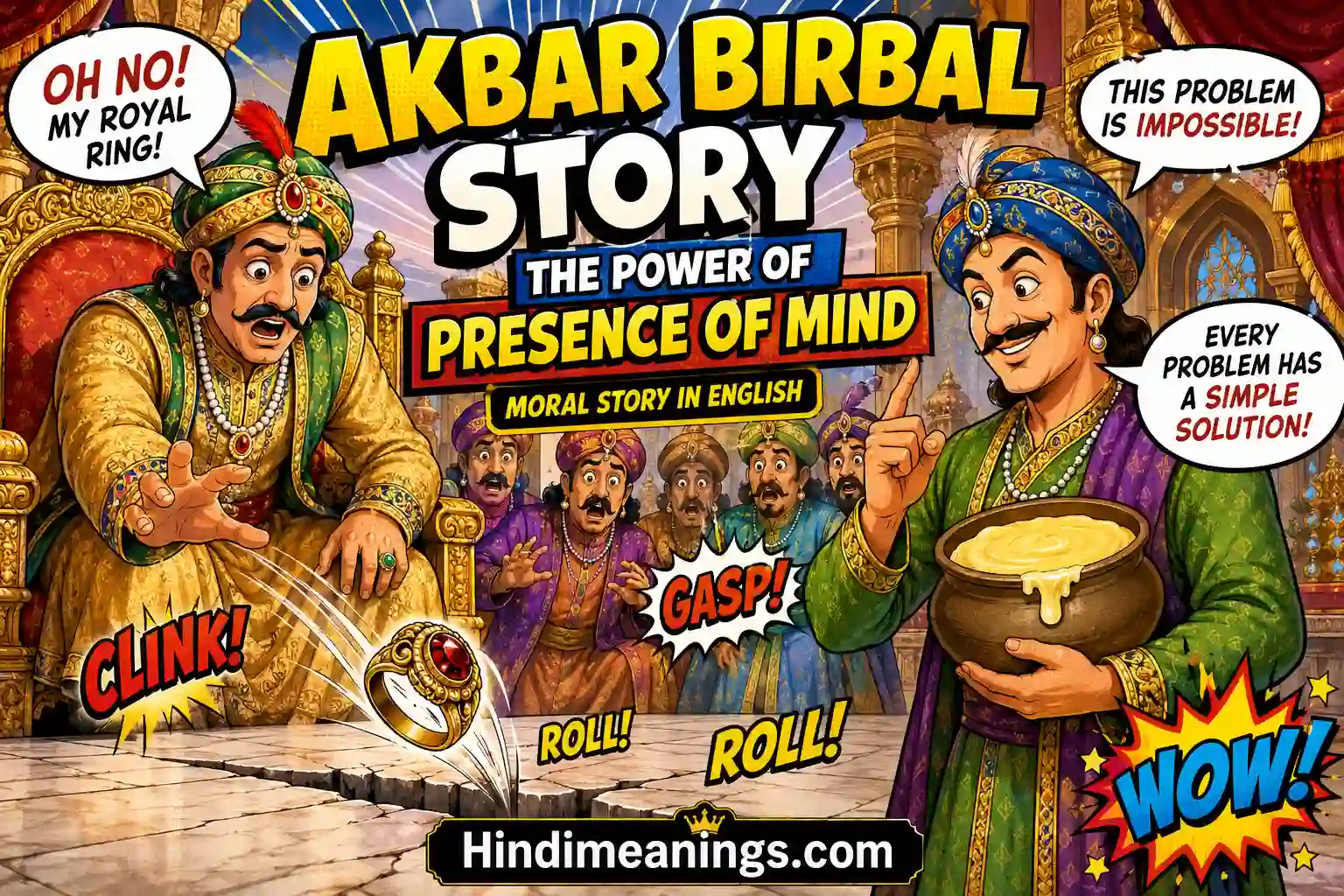
The timeless tales of Akbar and Birbal continue to captivate audiences across generations, teaching us valuable life lessons through wit, wisdom, and quick thinking. In this Akbar Birbal moral story, we explore how presence of mind and intelligent problem-solving can overcome the most challenging situations. This story, perfect for children and adults alike, demonstrates why Birbal was considered the wisest courtier in Emperor Akbar’s court.
The Golden Ring Mystery
It was a pleasant morning in the magnificent Mughal court of Emperor Akbar. The sun rays filtered through the ornate windows, casting beautiful patterns on the marble floor. The emperor sat on his royal throne, surrounded by his nine jewels (Navratnas), the most distinguished ministers of his kingdom. Among them sat Birbal, the emperor’s most trusted advisor and closest friend, known throughout the land for his extraordinary intelligence and sharp wit.
Akbar was in an excellent mood that day. He had just received news of a successful harvest across his empire, and the treasury was full. As he conversed with his courtiers about various matters of the state, he absentmindedly played with his favorite golden ring—a precious heirloom passed down through generations of Mughal emperors. The ring was adorned with a magnificent ruby that gleamed brilliantly in the morning light.
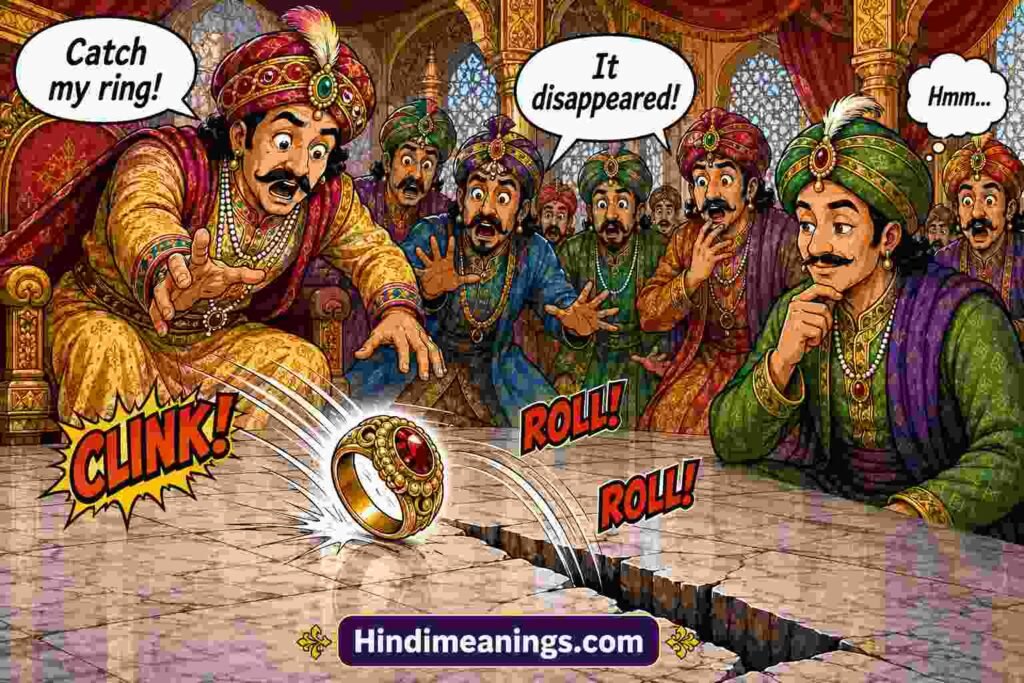
Suddenly, disaster struck. While gesturing during an animated discussion, the ring slipped from Akbar’s finger and fell to the floor with a soft clink. The entire court fell silent as everyone watched the precious ring roll across the smooth marble surface. It rolled and rolled, finally disappearing through a crack in the floor.
Emperor Akbar’s face turned pale. “My ring!” he exclaimed. “That ring has been in my family for five generations! Find it immediately!” The emperor’s distress was evident to everyone present. This was not just any piece of jewelry—it carried immense sentimental and historical value.
The Court’s Failed Attempts
Within minutes, the royal engineers and architects were summoned. They examined the crack in the floor carefully, measuring and calculating. The chief architect approached the emperor nervously and said, “Your Majesty, the ring has fallen into a very narrow gap between the marble slabs. The crack extends deep into the foundation of the palace. To retrieve the ring, we will need to break several marble tiles and dig into the structure.”
Akbar’s face showed his concern. “How long will this take?” he asked impatiently. The architect hesitated before replying, “At least three to four days, Your Majesty. We must work carefully to avoid damaging the palace structure. We’ll need to remove the marble slabs one by one, search through the foundation, and then restore everything as it was.”
The emperor was clearly disappointed. Four days seemed like an eternity to wait for his precious ring. Moreover, the court proceedings would be disrupted, and the beautiful marble floor would be torn apart. Several other courtiers offered their suggestions, but each solution seemed to involve extensive construction work, significant time, or substantial cost.
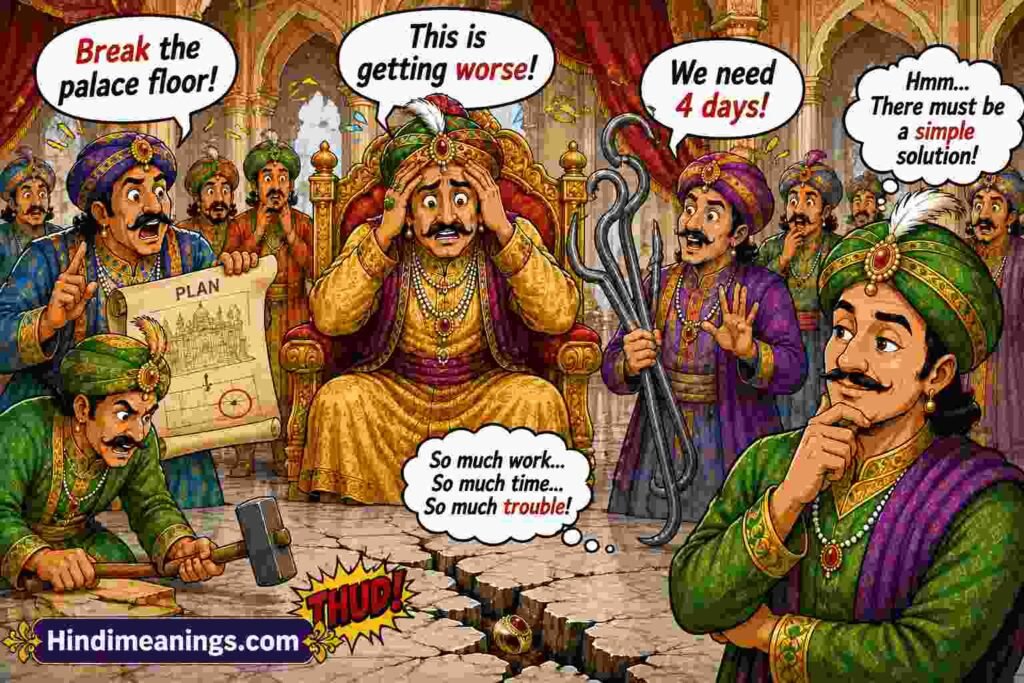
One minister suggested using long iron hooks to fish out the ring, but the architect explained that the crack was too narrow and twisted for any tool to reach. Another proposed pouring water into the crack to flush out the ring, but there was a risk that the water might push the ring even deeper or damage the palace foundation.
As the court debated various complicated solutions, Birbal sat quietly, observing everything with his characteristic calm demeanor. He closed his eyes for a moment, deep in thought, visualizing the problem from different angles. His mind worked like a precision instrument, considering and rejecting various possibilities.
Birbal’s Brilliant Solution
After a few moments of contemplation, a smile gradually appeared on Birbal’s face. He had found the answer—a solution so simple that everyone would wonder why they hadn’t thought of it themselves. This was Birbal’s gift: seeing simple solutions to complex problems while others got lost in complicated approaches.
Birbal stood up gracefully and approached the emperor. “Your Majesty,” he said respectfully, “if you permit me, I believe I can retrieve your ring within the next few minutes, without breaking a single marble tile or causing any damage to the palace.”
The entire court turned to look at Birbal in astonishment. How could he possibly achieve what the royal engineers said would take days? Was he boasting? The other courtiers exchanged skeptical glances. Some even smirked, thinking Birbal was being overconfident this time.
Emperor Akbar, however, knew Birbal well. He had seen his advisor solve countless impossible problems with his unique approach. “Please proceed, Birbal,” the emperor said with renewed hope. “Show us your method.”
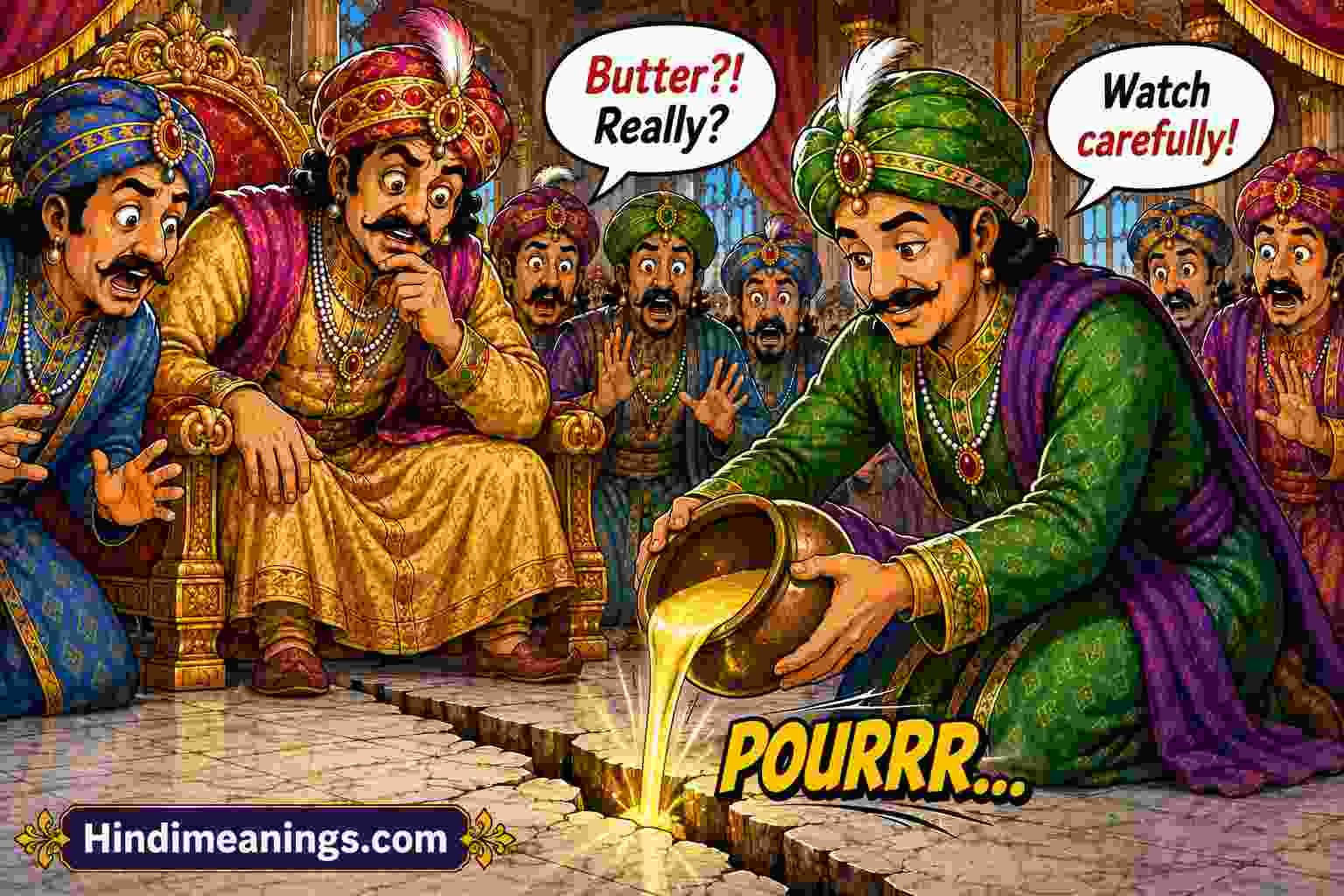
Birbal bowed and immediately called for a servant. “Bring me a pot of butter—the softest, purest butter from the royal kitchen,” he instructed. The court watched in confusion. Butter? What could butter possibly have to do with retrieving a ring from a crack in the floor?
Within moments, a servant arrived with a large pot of fresh, soft butter. Birbal took the pot and approached the crack where the ring had disappeared. He knelt down carefully, observed the crack closely, and then began to pour the melted butter slowly into the opening.
The courtiers watched in bewilderment. Some whispered among themselves, questioning Birbal’s sanity. “Has Birbal finally lost his mind?” one minister muttered. “How will butter help retrieve a gold ring?” another wondered aloud.
But Birbal continued patiently, pouring the butter steadily into the crack. The smooth, liquid butter flowed down into the narrow gap, filling every crevice. Everyone in the court stood in silence, watching this unusual spectacle unfold.
After a few minutes, something miraculous happened. The golden ring, coated in butter, began to slowly rise up through the crack! The butter’s buoyancy and lubricating properties had lifted the ring, bringing it back to the surface. The entire court gasped in amazement as the precious ring emerged from the crack, gleaming through its buttery coating.
Birbal carefully picked up the ring, wiped it clean with a soft cloth, and presented it to the emperor with a respectful bow. The ring shone as brilliantly as before, completely undamaged.
The Emperor’s Joy and the Moral Lesson
Emperor Akbar’s face lit up with pure joy. He examined the ring carefully, turning it over in his hands, and found it in perfect condition. Overcome with happiness and admiration, he embraced Birbal warmly. “Birbal, once again you have proven why you are the most valuable jewel in my court!” he exclaimed. “While others thought of complicated, time-consuming solutions involving destruction and reconstruction, you found a simple, elegant answer using just butter!”
The emperor turned to address his entire court. “Let this be a lesson to all of us,” he announced. “Sometimes the most effective solutions are not the most complicated ones. What appears to be an impossible problem often has a simple solution if we think creatively and calmly.”

Birbal bowed humbly and said, “Your Majesty, I simply observed that gold is denser than butter. When butter fills a space, lighter objects naturally rise to the surface. It’s a basic principle of nature. The real wisdom lies not in knowing complicated things, but in applying simple knowledge creatively to solve complex problems.”
The emperor nodded appreciatively and added, “You have taught us all an important lesson today, Birbal. Presence of mind and creative thinking are more valuable than any amount of resources or manpower. Your solution saved time, money, and prevented damage to our beautiful palace.”
To reward Birbal’s brilliance, Emperor Akbar gifted him a precious emerald ring and praised him before the entire court. The other courtiers, who had doubted Birbal moments earlier, now looked at him with renewed respect and admiration. They had witnessed once again why Birbal held such a special place in the emperor’s court.
The Deeper Meaning: Moral Values from This Story
This beautiful Akbar and Birbal story teaches us several valuable life lessons that remain relevant even in today’s modern world. Let’s explore the deeper meanings embedded in this simple yet profound tale.
1. The Power of Presence of Mind
Moral: The most important lesson from this story is the value of presence of mind. While others panicked and suggested complicated solutions, Birbal remained calm and thought clearly. In our daily lives, we often face unexpected challenges. Those who can remain composed under pressure and think rationally are better equipped to find effective solutions.
Whether you’re a student facing a difficult exam question, a professional dealing with a workplace crisis, or anyone navigating life’s unexpected turns, maintaining composure is key. This story teaches us that panic clouds judgment, while calmness brings clarity.
2. Simple Solutions to Complex Problems
Moral: We often complicate problems unnecessarily. Birbal’s butter solution reminds us that many complex-looking problems have simple answers if we look at them from the right angle. In today’s world, we’re often impressed by elaborate, technology-driven solutions, but sometimes the most elegant answer is the simplest one.
This principle applies to everything from problem-solving strategies in business to personal relationship issues. The lesson here is to step back, analyze the situation objectively, and look for the straightforward solution that others might overlook.
3. Knowledge Applied is Wisdom
Moral: Birbal didn’t possess any magical powers. He simply applied basic scientific knowledge—understanding density and buoyancy—in a creative way. This teaches us that true intelligence lies not in accumulating information but in knowing how to apply knowledge practically.
As students and professionals, we should focus not just on learning but on understanding how to use what we learn in real-world situations. Book knowledge becomes valuable only when we can apply it to solve actual problems.
4. Patience and Observation
Moral: Notice how Birbal didn’t immediately jump to provide a solution. He observed quietly, thought deeply, and only spoke when he had a clear plan. In our fast-paced world, we’re often pressured to respond instantly.
This story reminds us that taking a moment to think, observe, and plan can lead to much better outcomes than hasty reactions. Sometimes the best action is to pause, think, and then act with confidence.
5. Humility in Success
Moral: Even after solving the problem brilliantly, Birbal remained humble. He didn’t boast about his intelligence but simply explained the scientific principle behind his solution. True wisdom includes humility. Success should make us grateful, not arrogant.
This is a crucial value for personal and professional growth. When we achieve something, we should acknowledge it gracefully but remain grounded and respectful to others.
Why Akbar-Birbal Stories Matter Today
The Akbar Birbal stories have survived centuries because they contain timeless wisdom packaged in entertaining narratives. These stories are not just historical anecdotes—they’re educational tools that teach critical thinking, problem-solving, and ethical values.
In our modern education system, we often focus heavily on theoretical knowledge while neglecting practical wisdom and creative thinking. Stories like these help bridge that gap. They show us that intelligence isn’t just about memorizing facts or following standard procedures—it’s about thinking independently, creatively, and practically.
For children, these stories serve as excellent bedtime reading that entertains while educating. For adults, they offer moments of reflection about our own approaches to problem-solving and decision-making. If you enjoyed this story, you might also appreciate our other Akbar Birbal story about the wisest man, which teaches similar valuable lessons about wisdom and judgment.
Historical Context: Who Were Akbar and Birbal?
Emperor Akbar (1542-1605) was the third Mughal emperor and one of the greatest rulers in Indian history. He was known for his military prowess, administrative skills, and religious tolerance. His reign from 1556 to 1605 is considered the golden age of the Mughal Empire.
Birbal, whose real name was Mahesh Das, was born in 1528 in a poor Brahmin family. He rose to become one of the nine gems (Navratnas) in Akbar’s court. Beyond the folklore, historical records confirm that Birbal was indeed a trusted advisor to Akbar, known for his wit, poetry, and administrative capabilities. He died in 1586 during a military campaign.
The stories of Akbar and Birbal, while some may be embellished over centuries, capture the essence of their relationship and Birbal’s legendary intelligence. These tales have been passed down through oral tradition and written texts, becoming an integral part of Indian cultural heritage.
How to Apply These Lessons in Daily Life
The wisdom from this Akbar-Birbal story isn’t meant to remain confined to the pages of a book. Here’s how you can apply these lessons practically in different areas of your life:
For Students: When you encounter a difficult problem in mathematics or science, don’t immediately panic or give up. Take a moment to breathe, look at the problem from different angles, and try to apply basic principles in new ways. Sometimes the solution is simpler than it appears. Break down complex problems into smaller, manageable parts.
For Professionals: In the workplace, when facing a challenge, resist the urge to immediately propose the most expensive or complicated solution. Often, clients and managers appreciate elegant, simple solutions that save time and resources while effectively solving the problem. Think creatively, consider unconventional approaches, and don’t be afraid to suggest simple solutions.
For Parents: When your children face difficulties, encourage them to think creatively rather than always providing direct answers. Ask questions that guide them toward finding solutions themselves, just as Birbal demonstrated independent thinking. Help them develop problem-solving skills that will serve them throughout their lives.
In Relationships: Many conflicts arise from complicated misunderstandings. Sometimes, a simple, honest conversation—like Birbal’s simple butter solution—can resolve issues that seem insurmountable when we overthink them. Don’t let ego or pride prevent you from choosing the straightforward path to resolution.
The Science Behind Birbal’s Solution
For those curious about the scientific principle Birbal used, let’s explore the concept briefly. The solution worked because of the principle of buoyancy and density. Gold has a density of approximately 19.3 grams per cubic centimeter, while butter has a density of only about 0.9 grams per cubic centimeter.
When butter is poured into a confined space, it fills all available gaps. Objects denser than butter (like gold) will initially sink, but as butter accumulates below them and fills the space, those objects are pushed upward. The lubricating property of butter also helps the ring slide smoothly through the narrow crack without getting stuck.
This is similar to how oil floats on water or how certain objects rise to the surface when submerged in liquids. Birbal understood and applied this natural principle of physics in a practical, creative way—a perfect example of applied science. This demonstrates how understanding basic scientific principles can help solve everyday problems.
Other Lessons from Indian Folklore
Indian culture is rich with similar stories that teach moral values through entertaining narratives. If you appreciate the wisdom in Akbar-Birbal tales, you might also enjoy exploring other traditional stories like Atithi Devo Bhava stories that teach the importance of hospitality and treating guests with respect, or the Panchatantra tales that have been educating children for thousands of years.
These stories are not just entertainment—they’re vehicles for transmitting cultural values, ethical principles, and practical wisdom from one generation to the next. In an age dominated by digital media and fast-paced content, these timeless tales offer depth, reflection, and genuine life lessons that stand the test of time.
Hindi Meanings: Important Words from the Story
To help Hindi-speaking readers better understand this story, here are the Hindi translations of important words and phrases used throughout the narrative:
- Presence of Mind – उपस्थित बुद्धि / सूझबूझ (Upasthit Buddhi / Soojhboojh)
- Wisdom – बुद्धिमत्ता / ज्ञान (Buddhimatta / Gyaan)
- Emperor – सम्राट / बादशाह (Samrat / Badshah)
- Courtier – दरबारी / राजदरबारी (Darbaari / Rajdarbaari)
- Magnificent – भव्य / शानदार (Bhavya / Shaandaar)
- Heirloom – पुश्तैनी वस्तु / वंशानुगत संपत्ति (Pushtaini Vastu / Vanshaanugat Sampatti)
- Architect – वास्तुकार / शिल्पकार (Vastukaar / Shilpkaar)
- Foundation – नींव / आधार (Neenv / Aadhaar)
- Contemplation – चिंतन / विचार (Chintan / Vichaar)
- Astonishment – आश्चर्य / हैरानी (Aashcharya / Hairaani)
- Bewilderment – उलझन / भ्रम (Uljhan / Bhram)
- Buoyancy – उछाल / प्लवनशीलता (Uchhaal / Plavansheelataa)
- Density – घनत्व / सघनता (Ghanatva / Saghanataa)
- Humility – विनम्रता / नम्रता (Vinamrata / Namrata)
- Composure – धैर्य / संयम (Dhairya / Sanyam)
- Creative Thinking – रचनात्मक सोच / सृजनात्मक विचार (Rachnaatmak Soch / Srijanaatmak Vichaar)
- Problem-solving – समस्या समाधान / समस्या को सुलझाना (Samasya Samaadhaan / Samasya Ko Suljhaana)
- Intelligent – बुद्धिमान / समझदार (Buddhimaan / Samajhdaar)
- Solution – समाधान / हल (Samaadhaan / Hal)
- Challenge – चुनौती / कठिनाई (Chunauti / Kathinaai)
- Observation – निरीक्षण / अवलोकन (Nireekshan / Avalokan)
- Patience – धैर्य / सब्र (Dhairya / Sabr)
- Admiration – प्रशंसा / सराहना (Prashansa / Saraahna)
- Gratitude – कृतज्ञता / आभार (Kritagyata / Aabhaar)
Understanding these Hindi meanings will help readers appreciate the story in both languages and enhance their vocabulary in both English and Hindi.
Conclusion: The Timeless Wisdom of Presence of Mind
The story of Birbal and the golden ring beautifully illustrates that true intelligence isn’t about knowing everything—it’s about thinking clearly, applying knowledge creatively, and maintaining composure under pressure. In a world that often values speed over thoughtfulness and complexity over simplicity, this ancient tale reminds us of the power of presence of mind.
Whether you’re a student preparing for exams, a professional navigating workplace challenges, a parent guiding children, or simply someone trying to live wisely, the lessons from this Akbar Birbal moral story are universally applicable. The next time you face a difficult situation, remember Birbal’s approach: stay calm, think clearly, observe carefully, and look for the simple solution that others might overlook.
These stories have survived centuries not because they’re mere fairy tales, but because they contain genuine wisdom that helps us navigate life’s complexities. Share this story with your children, discuss it with friends, and most importantly, apply its lessons in your daily life. After all, the true value of wisdom lies not in knowing it, but in living it.
What did you learn from this story? How do you plan to apply presence of mind in your daily challenges? Share your thoughts and experiences in the comments below!