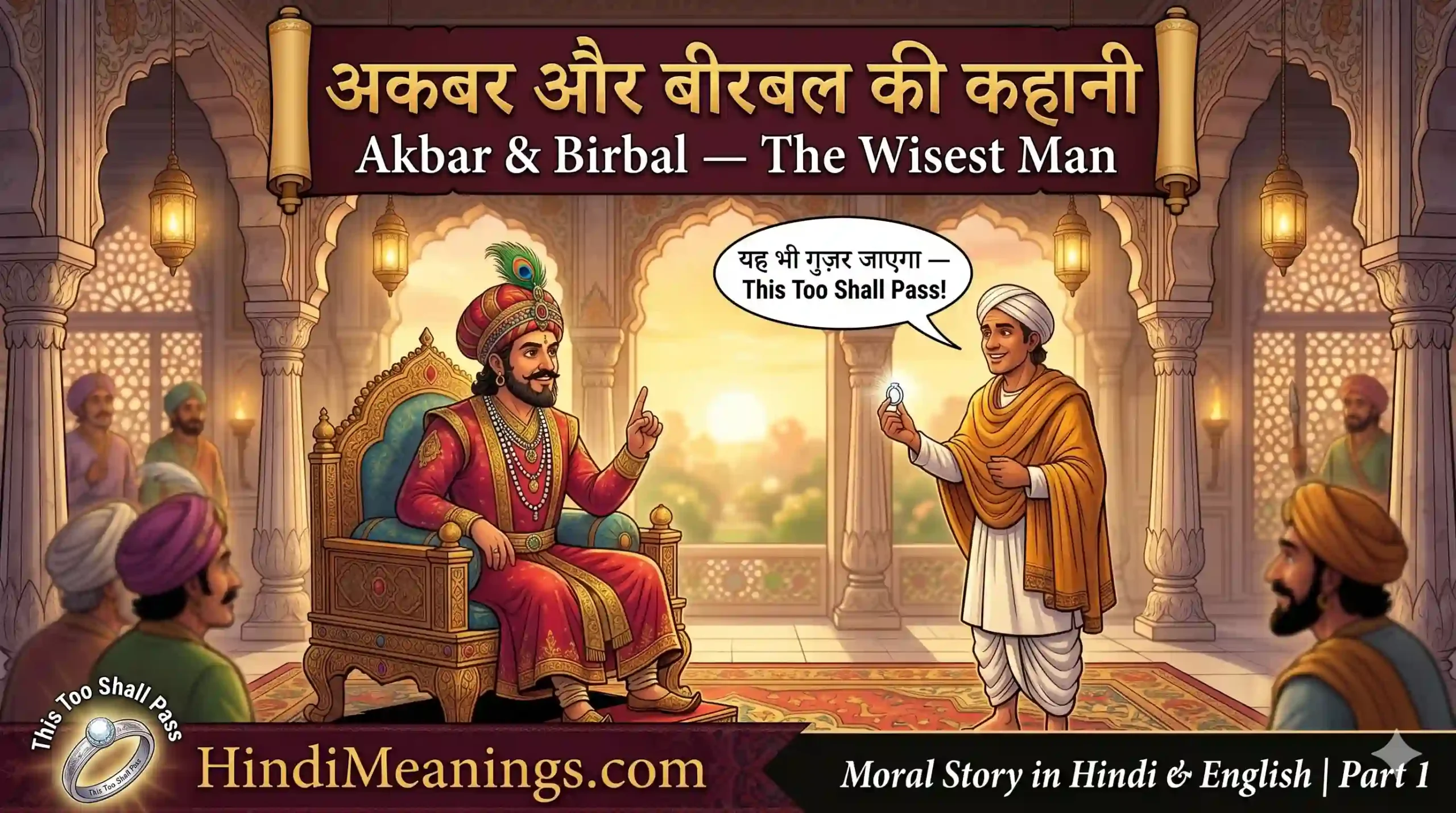
If there is one pair of characters from Indian history whose stories have never grown old, it is Akbar and Birbal. Emperor Akbar ruled the Mughal Empire with power and fairness, and his court was filled with talented ministers — but none was as sharp, witty, and wise as Birbal (also spelled Birbal in Hindi: बीरबल). Their stories have been told for centuries across India, in classrooms, grandmothers’ laps, and bedtime readings. Today, we bring you one of the most beloved Akbar and Birbal stories with moral, presented in both English and Hindi so that children and students across all age groups can enjoy and learn from it.
This is not just a story — it is a life lesson wrapped in humor, a challenge wrapped in simplicity. Read on, and discover why Birbal was truly the wisest man in Akbar’s kingdom.
Akbar and Birbal Story: The Wisest Man in the Kingdom
Introduction – Who Were Akbar and Birbal?
Emperor Akbar (1542–1605) was the third and greatest ruler of the Mughal Empire in India. He was known not only for his military power but also for his love of knowledge, art, and wisdom. His court, famously called the Navaratnas (Nine Jewels), included nine brilliant men — and the brightest among them was Birbal, whose real name was Raja Mahesh Das Bhatt.
Birbal was a poet, a storyteller, and above all — a master of wit. He could solve the most complicated problems with the simplest answers. Akbar loved testing Birbal, and Birbal always emerged victorious. Their interactions gave birth to hundreds of classic short moral stories in Hindi and English that continue to inspire millions of children across India and the world.
If you enjoy learning through stories, you may also like our popular article on Short Story About Honesty – The Lost Wallet, which carries a similarly powerful message for young readers.
The Story Begins – A Royal Challenge
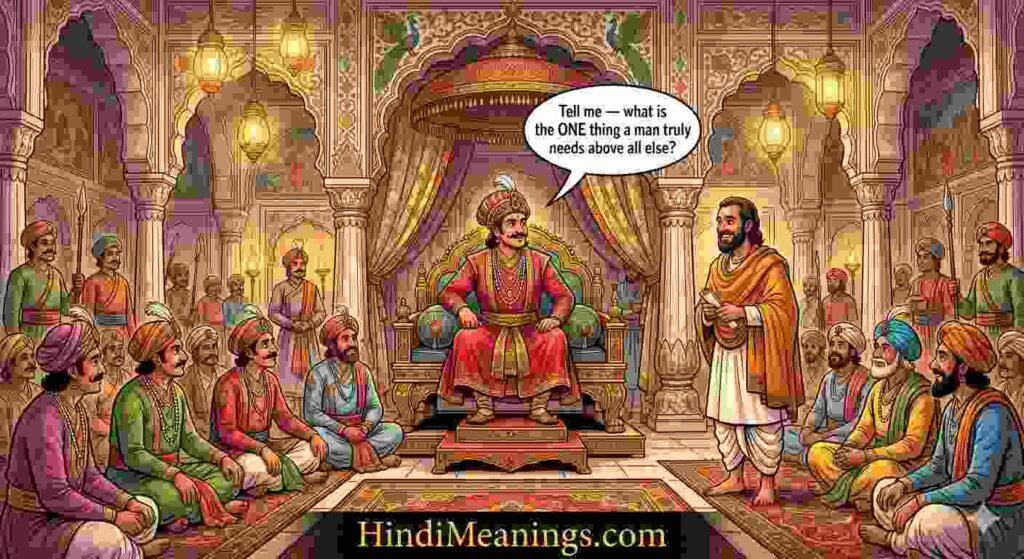
One fine spring morning, Emperor Akbar sat in his grand Durbar (royal court). He was in a playful mood. He had been thinking about a question for many days, and he decided it was finally time to put it to his ministers.
He raised his hand for silence. The murmur of the court faded instantly.
“I have a question,” said Akbar, his eyes gleaming with mischief. “Tell me — what is the one thing that, if a man has it, he needs nothing else in the world? And if a man lacks it, nothing else he owns is of any use to him?”
The court fell silent. Ministers exchanged glances. Some stroked their beards thoughtfully. Others whispered amongst themselves.
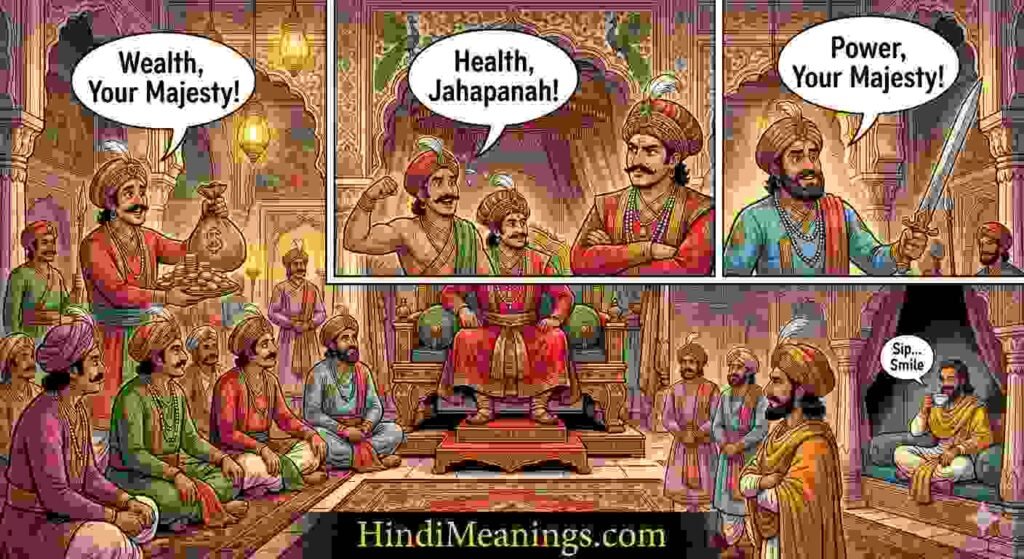
One minister stood up. “Jalal-ud-din Akbar, greatest of emperors — the answer is wealth. With wealth, a man can buy anything.”
Akbar shook his head slowly. “Sit down.”
Another minister rose. “Maharaj, the answer must be health. A sick man cannot enjoy even his riches.”
Akbar smiled politely but shook his head again.
A third minister said, “Power, Your Majesty. Power over others makes everything possible.”
Still, Akbar was not satisfied.
One by one, ministers offered their answers — gold, love, God’s blessings, a good name. Each time, Akbar rejected them. Finally, all eyes turned to Birbal, who had been sitting quietly in the corner, a small smile playing on his lips.
Birbal’s Clever Answer
Akbar raised an eyebrow. “Birbal, you have been quiet. Surely you, my wisest minister, have an answer?”
Birbal stood up calmly, folded his hands in respect, and said, “Huzoor, the answer is wisdom — Vivek (विवेक).”
The court murmured. Some ministers chuckled. “Wisdom?” one whispered. “That’s not even a physical thing!”
Akbar leaned forward, curious. “Explain yourself, Birbal.”
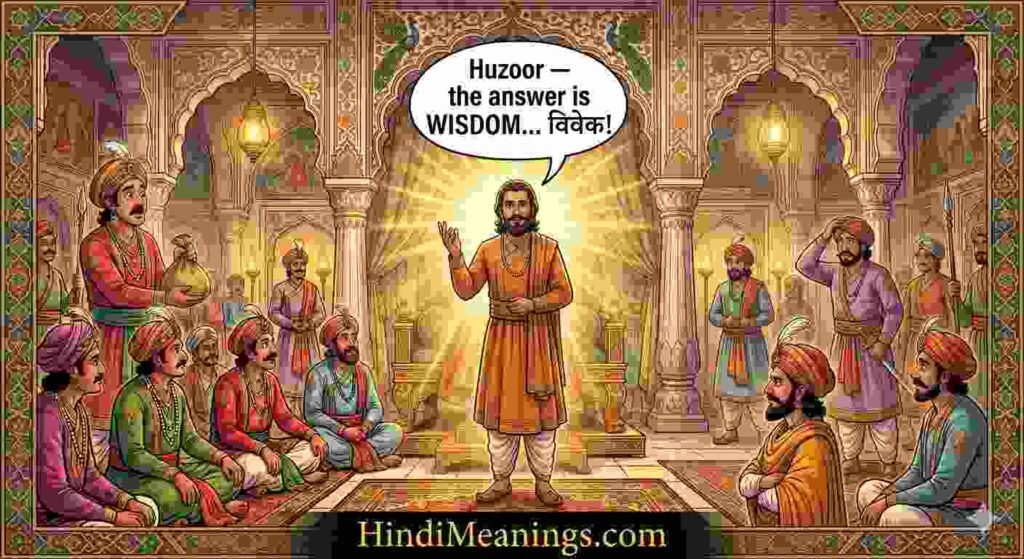
Birbal nodded respectfully. “Jahanpanah, consider this — a man with great wealth but no wisdom will squander his riches and be left with nothing. A man with perfect health but no wisdom will make reckless choices and destroy himself. A man with power but no wisdom will become a tyrant and be overthrown. But a man with wisdom — even if he is poor, even if he is sick, even if he has no power — he will find a way. He will earn respect, solve problems, and make something out of nothing.”
The court was silent.
Birbal continued. “And Huzoor, here is the test — look at this court. Every minister here has wealth. Every minister here is healthy. Many have power. But when you asked one simple question, only wisdom could answer it. So I ask — what is the one thing that truly matters?”
Akbar burst into laughter and applause. “Birbal, you have done it again!” he cried. “You are right. Wisdom is the greatest treasure a man can possess. Without it, everything else is meaningless.”
The other ministers bowed their heads in agreement — and a little shame.
But Akbar Was Not Done Yet – The Second Test
As the laughter died down, Akbar’s expression turned serious. He had enjoyed Birbal’s answer, but he wanted to truly test his minister’s wisdom — not just in words, but in action.
“Very well, Birbal,” he said. “Words are easy. Now prove it. I will give you a task, and you must use only wisdom — no gold, no authority, no help from anyone. Complete the task by sunset tomorrow, and I will give you a diamond. Fail, and you will serve in the royal stables for a month.”
Birbal bowed. “I accept, Jahanpanah. What is the task?”
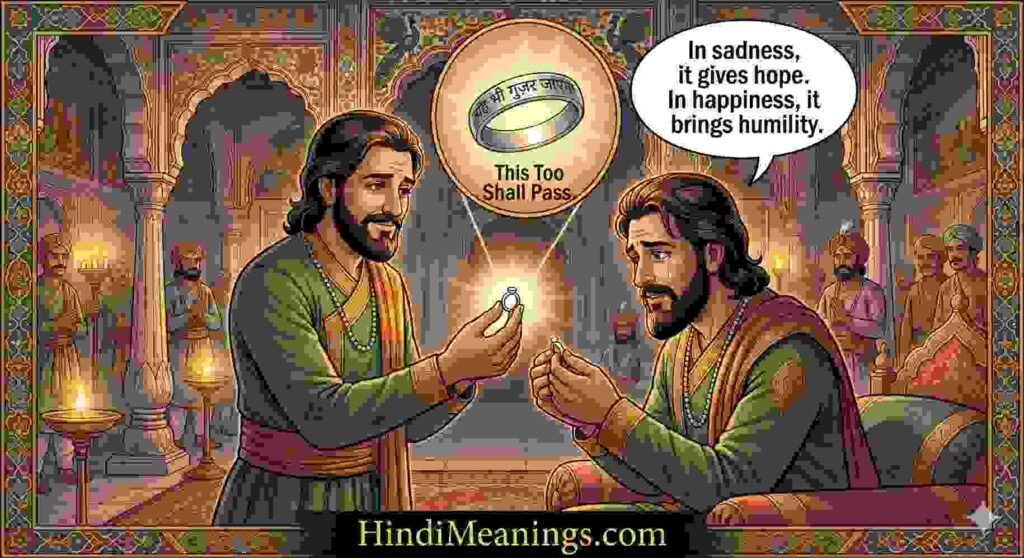
Akbar smiled. “Simple. Bring me something that makes a sad man happy and a happy man sad — at the exact same time. You have until sunset tomorrow.”
The ministers laughed. Surely this was impossible! How could one thing make a person both happy and sad simultaneously?
Birbal smiled, bowed again, and left the court.
Birbal’s Masterstroke – The Answer Revealed
The next day, as the golden sun began its slow descent toward the horizon, Birbal walked back into the Durbar. In his hand, he carried a small, ordinary-looking ring.
Akbar studied it carefully. It was a simple silver ring — nothing special about it. But engraved on the inside of the band were four words in Persian: “Yeh Bhi Guzar Jayega” — meaning “This Too Shall Pass.”
Akbar read the words. He read them again. Then slowly, a wide smile spread across his face.
“Explain,” said the Emperor softly.
Birbal spoke. “Huzoor, when a sad man reads these words — This Too Shall Pass — he feels hope. He thinks: my pain, my sorrow, my struggles — they will not last forever. This fills him with happiness and courage. But when a happy man reads the very same words, he feels a pang of sadness — because he realizes that his joy, his success, his golden moment — it too will not last forever. Thus, the same four words make a sad man happy and a happy man sad.”
The court was completely still.
Then Akbar rose from his throne and walked to Birbal. He removed the diamond from his own ring and placed it in Birbal’s palm. “You have not only completed the task,” said the Emperor, “you have taught every person in this court a lesson they will never forget. Birbal — you are not just the wisest man in my kingdom. You may be the wisest man in the world.”
Akbar Birbal Ki Kahani – Hindi Mein (अकबर बीरबल की कहानी – हिंदी में)
एक दिन, अकबर अपने दरबार में बैठे थे। उनके मन में एक प्रश्न था जो बहुत दिनों से घूम रहा था। उन्होंने दरबारियों से पूछा:
“बताओ — वह कौन-सी चीज़ है जो अगर इंसान के पास हो, तो उसे और कुछ नहीं चाहिए? और अगर न हो, तो बाकी सब बेकार है?”
दरबारियों ने कई जवाब दिए — धन, स्वास्थ्य, सत्ता, प्रेम — पर बादशाह किसी से संतुष्ट नहीं हुए।
अंत में बीरबल बोले: “जहाँपनाह, वह चीज़ है — विवेक (बुद्धि)।”
और बीरबल ने समझाया — बिना बुद्धि के धन बर्बाद होता है, बिना बुद्धि के स्वास्थ्य का उपयोग नहीं होता, और बिना बुद्धि के सत्ता अत्याचार बन जाती है। लेकिन जिसके पास विवेक है, वह गरीब होकर भी रास्ता निकाल लेता है।
अकबर ने ताली बजाई और फिर बीरबल को दूसरी परीक्षा दी — ऐसी चीज़ लाओ जो दुखी को खुश और खुश को दुखी करे — एक साथ।
अगले दिन बीरबल एक छोटी-सी अंगूठी लेकर आए, जिस पर लिखा था: “यह भी गुज़र जाएगा।”
दुखी इंसान पढ़े तो सोचे — मेरा दर्द भी जाएगा — और खुश हो जाए। खुश इंसान पढ़े तो सोचे — मेरी खुशी भी जाएगी — और उदास हो जाए।
अकबर अपने सिंहासन से उठे और बीरबल को हीरा दिया। बोले — “बीरबल, तुम सिर्फ मेरे दरबार के नहीं, शायद पूरी दुनिया के सबसे बुद्धिमान इंसान हो।”
Moral of the Akbar and Birbal Story – कहानी की सीख
The moral of this Akbar Birbal story is two-fold and deeply meaningful:
- Wisdom (Vivek) is the greatest wealth a person can have. It outlasts money, beauty, and power. Cultivate your mind, and you will always find a way forward — no matter the circumstances.
- “This Too Shall Pass” is one of the most powerful truths of life. Nothing — neither pain nor joy — is permanent. In sorrow, these words bring hope. In happiness, they bring humility. Together, they teach us to live with balance and gratitude.
कहानी की सीख: बुद्धि (विवेक) सबसे बड़ी दौलत है। और जीवन में हर चीज़ अस्थायी है — चाहे सुख हो या दुख। यही समझ इंसान को महान बनाती है।
Why Akbar and Birbal Stories Are Important for Children
Akbar Birbal short stories with moral are a cornerstone of Indian children’s literature for several important reasons:
- They develop critical thinking — Children learn that there is always a clever solution to every problem.
- They build vocabulary — Many Akbar Birbal stories include rich Hindi words and idioms that strengthen language skills. For example, learning words like vivek (विवेक = wisdom), durbar (दरबार = royal court), and jahanpanah (जहाँपनाह = your majesty) is a wonderful way to expand your Hindi and English vocabulary.
- They teach morals gently — Unlike direct lectures, stories plant lessons in the heart without force.
- They celebrate Indian culture — These stories are rooted in the rich Mughal-era history of India and help children connect with their heritage.
More Akbar and Birbal Stories – Coming Soon
This is the first story in our Akbar and Birbal series on HindiMeanings.com. We will be publishing a complete collection of Akbar Birbal stories in Hindi and English with moral lessons, including:
- Akbar Birbal and the Farmer’s Well
- Birbal’s Khichdi (The Coldest Night)
- How Many Crows Are in Agra?
- Birbal and the Three Questions
- The Weight of a Sparrow
Bookmark this page and keep visiting HindiMeanings.com so you never miss a new story. You can also explore our other moral stories such as The Magical Tales: Fables of the Prophets in Hindi and Luna and the Land of Dreams – A Magical Bedtime Story for children.
FAQs About Akbar and Birbal Stories
Q1. What is the best Akbar Birbal story for kids?
The best Akbar Birbal story for kids is one that combines humor with a clear moral lesson. Stories like “The Wisest Man in the Kingdom,” “Birbal’s Khichdi,” and “How Many Crows Are There?” are all-time favorites because they are simple to understand yet carry deep wisdom.
Q2. What is the moral of Akbar and Birbal stories?
Most Akbar Birbal stories with moral teach values such as wisdom over wealth, cleverness over brute force, honesty, humility, and the importance of thinking before acting. The moral varies story to story, but each one leaves the reader with a meaningful life lesson.
Q3. Are Akbar Birbal stories real or fictional?
Akbar and Birbal were real historical figures. Emperor Akbar was the third Mughal Emperor of India, and Birbal (born Raja Mahesh Das Bhatt) was his trusted advisor and court poet. However, most of the Akbar Birbal stories we read today are folk tales and literary creations inspired by their real relationship, passed down through generations of oral storytelling tradition in India.
Q4. In which language are Akbar Birbal stories available?
Akbar Birbal ki kahaniyan are available in nearly every major Indian language — Hindi, English, Urdu, Bengali, Marathi, Tamil, Telugu, and more. On HindiMeanings.com, we publish them in both Hindi and English so that children and parents across India and the world can enjoy them together. If you are also learning Hindi numbers or vocabulary, check out our guide on Numbers in Hindi 1 to 50 — a fun way to build Hindi language skills alongside these stories.
Conclusion – The Wisdom of “This Too Shall Pass”
The story of the Wisest Man in the Kingdom is more than an Akbar Birbal tale — it is a timeless piece of human wisdom. In a world full of noise and distraction, these four words — “Yeh Bhi Guzar Jayega” (This Too Shall Pass) — carry extraordinary power.
Whether you are a student facing exams, a parent facing hardships, or a child just beginning to understand the world — carry these words with you. They will bring you comfort in darkness and keep you grounded in joy.
And remember: Wisdom is the one treasure that can never be stolen, never be lost, and only grows with time.
Stay tuned to HindiMeanings.com for more Akbar and Birbal stories in Hindi and English with moral lessons for kids and students. If you enjoyed this story, share it with your friends and family — because good wisdom, like a good story, deserves to be passed on.
<hr class=”wp-block-separator”/>
For more educational content in Hindi and English, visit HindiMeanings.com — your trusted learning companion.
For the latest tips on digital learning and educational technology, visit PGUpdate.in.